
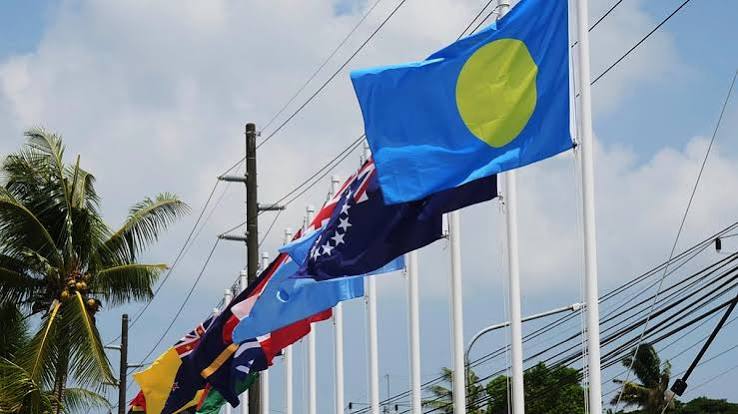
Leaders of some of the least populous states in the world are gathering in a serene tropical archipelago without traffic lights, far from New York or Davos. As representatives from dozens of nations came for the Pacific Islands Forum Leaders Meeting, the population of Palau, the summit host, was expected to increase from 18,000 to 20,000.
The president of the nation and other high-ranking officials picked up rubbish on the island's main thoroughfare prior to the summit's official opening on Monday. Students volunteered to usher dignitaries, and barbers and tattoo artists got ready to drive delegates.
Beneath the event's peculiarly Pacific nature, however, where decisions are made by agreement rather than by a vote and events evolve in their own leisurely pace, simmered a tense and intensifying geopolitical dispute about who gets to determine the destiny of the huge ocean region.
The struggle for influence between China and the United States, Taiwan, and forum members Australia and New Zealand has intensified in recent years as powerful nations interested in the Pacific have rushed to strengthen ties among its leaders. The forum's members have become divided as a result of the occasionally competing attempts to gain influence, endangering yearly conferences.
Palau's President Surangel Whipps Jr. told reporters on Sunday, "The Pacific is our home, not a theater for geopolitical competition," urging the larger nations watching this week's event to refrain from interfering in discussions that he hoped would focus on issues that are gravely endangering small Pacific island nations, like climate change and faltering economies.He continued, "Let's not use this as a place where we should be intimidating or upsetting people. But the reality was not likely to be straightforward.
Little island nations are now crucial friends
The Pacific Islands Forum's 18 member nations and territories, some of which have populations in the low thousands or tens of thousands, were formerly mostly recognized as idyllic vacation spots. However, several also have expansive and profitable exclusive economic zones that are rich in seabed minerals and fisheries. As tensions across the world increase, their locations throughout the vast Pacific Ocean have become strategically significant points on the map.
Although Forum nations frequently refer to themselves as a "Pacific family," their members come from a variety of political and cultural backgrounds, and their remote locations make it difficult for leaders to have face-to-face conversations.
The leaders' ability to speak with one voice at their annual summit has been put under pressure as major powers have increased their efforts over the past ten years to secure access to Pacific waters and ports by signing security agreements and providing funding, immigration access to their nations, and other sweeteners.Oliver Nobetau, the Pacific Islands program director of the Australian think tank Lowy Institute, stated, "We see instances where that consensus-based model, which is referred to as the Pacific Way, can sometimes lead to a bit of paralysis in taking action."Pacific countries are dealing with petroleum shocks and a deteriorating climate.
"At this point in time when Pacific Islands are facing a lot of acute security issues, decision-making is paramount for this one," Nobetau stated. "We'll be looking to see if President Whipps can sort of steer the forum to take tangible action."
The repercussions of the most recent El Nino meteorological disruption, which has brought droughts and floods throughout the region, are among the problems plaguing Pacific island nations. Food security and access to clean water, which are already precarious in island nations that rely heavily on international aid and import goods, are threatened by the unpredictable weather.
In a region that is heavily dependent on imported diesel and gasoline that arrive via a precarious supply chain, fuel volatility brought on by the Iran war has also led to the declaration of national emergencies in some Pacific countries that are experiencing significant economic shocks.
This week, Whipps proposed that the wealthier nations looking to become involved in the area should open their wallets to fund the extensive development of solar power capabilities throughout the region.Whipps said, "What are they doing with us to partner to get a 100% renewable Pacific?"Members' alliances will inevitably cause conflict.
Nonetheless, this year's summit was always going to be seen as a confrontation by some of the regional powers at odds.
It is also at the center of other major power conflicts. Palau, which is situated next to the Philippines in the western Pacific Ocean, benefits from the Asian tourism industry and has stronger ties to the US than many of the Forum's members. In exchange for tens of millions of dollars in annual US aid, a Compact of Free Association grants the US access to Palau's territory for defense and security purposes.
Palau's hosting role coincides with the summit's leaders attempting once more to develop a framework governing the participation of other nations in its sessions. Taiwan has a distinct position as a development partner, while nations authorized to participate in the Pacific Islands Forum, such as the United States and China, are referred to as dialog partners.
Beijing has increased pressure on forum hosts to keep Taipei's envoys out of the yearly summit. This disagreement became so heated prior to the Solomon Islands event in 2025 that all nations other than member states were completely prohibited from attending. Taiwan's Foreign Minister Lin Chia-lung attended this year due to Palau's cordial diplomatic ties with Taipei, which prompted Beijing to issue a warning that China would not allow Taiwanese officials to participate.
As a result, some officials and Pacific observers are frustrated about the possibility of another summit being dominated by rivalry between non-member nations.
The news that one leader, Solomon Islands Prime Minister Matthew Wale, a recently elected leader more friendly to Australia than the more Beijing-aligned leader before him, had returned home just hours after arriving due to an opponent mounting a leadership challenge, rocked early arrivals over the weekend.
The extent to which his forced departure and the absence of others, like President Taneti Maamau of Kiribati, whose nation's relations with China have improved under his leadership, could be linked to concerns about the geopolitics of the summit was not immediately apparent.
"If you claimed it wasn't a major issue, you would be defying logic and gravity," Winston Peters, the foreign minister of New Zealand, addressed bids for foreign meddling in the event to reporters in Koror on Sunday.
According to Peters, the leaders' absences were "seriously disappointing" and unhelpful."However, the delegations are generally of the highest caliber," he stated. "Well, let's see."


