
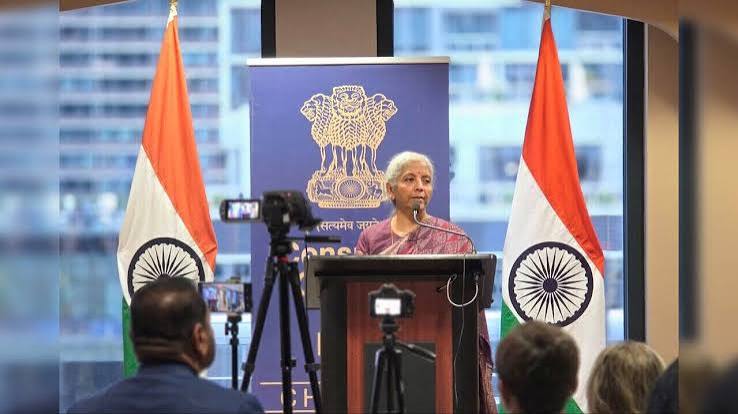
Finance Minister Nirmala Sitharaman stated on Saturday that India is on pace to reduce its government debt to 50% of GDP by 2030, emphasizing that fiscal consolidation will continue without sacrificing social welfare spending.
The Finance Minister stated that the government had set a goal to cut borrowing to 50% of GDP by 2030 while speaking to the Indian diaspora in Chicago.Our goal is to reduce borrowing to 50% of GDP by 2030. I shall therefore be pursuing that course," Sitharaman declared.
She said that the administration had also reached the last milestone for 2025–2026 and the fiscal deficit consolidation route it had set for itself.
According to Sitharaman, the government's economic management and fiscal restraint were reflected in India's rising credit ratings. However, she claimed that social welfare spending had not increased as a result of the improvement.
"Our credit scores are becoming better. But it's not by taking short cuts. That's not by cutting off funds that must be used for social welfare. It is by managing the economy well," she stated.According to the Finance Minister, the Viksit Bharat vision calls for India to become a developed economy by 2047.
"Therefore, the speed and scale with which the reforms are happening require a lot more support," she stated, urging the Indian diaspora to provide more capital, ideas, and experience.
Sitharaman also emphasized how the administration handled disruptions in global supply, such as shortages of fertilizers, LPG, and crude oil.
She claimed that by consistently informing international markets about its needs even when global supplies decreased, India was able to avert a significant shortage of fertilizer.
Growing dangers in international shipping made the situation more challenging. Risk premiums rose sharply, and ships transporting vital supplies had trouble finding sufficient insurance coverage.
In response, the government established a fund that was included in the budget to help shipping businesses pay higher insurance rates due to the increased risks, she said.
Indian households, Indian farmers, and Indian logistics did not suffer as a result, according to Sitharaman.
She claimed that despite the difficult external environment, India has remained resilient thanks to the government's capacity to keep an eye on world events while evaluating the country's domestic needs.
In the midst of these uncertainties, many nations have seen their estimates go awry. Fortunately, we have kept our folks safe in this difficult climate despite our constraints," she stated.


