
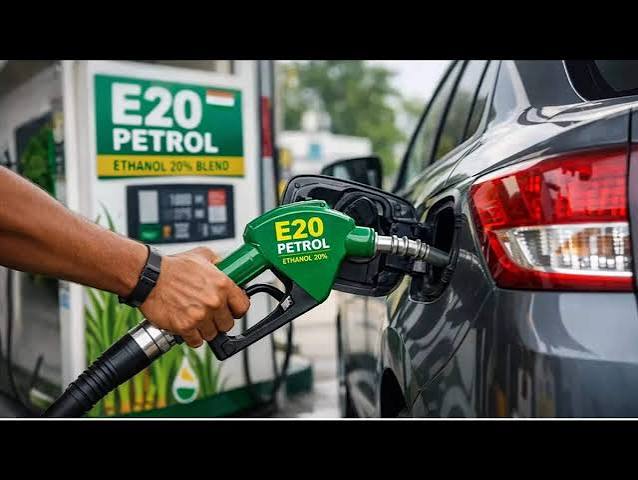
Five years ahead of schedule, India achieved 20 percent ethanol blending in 2025. E20 was the standard gasoline at gas stations across the country by April 2026. When compared to its own goal, the ethanol-blended gasoline initiative is among the best industrial strategies of the last ten years. It now merits closer examination because of this.
It's not just whether E20 affects engines or lowers mileage. The main moral argument for the program is whether or not the farmer, who pays for the mix and collects the rent, is at the front of the line.
On the surface, the government's ledger appears remarkable. The Ministry of Petroleum and Natural Gas estimates that since 2014–15, there have been around ₹1.97 lakh crore in foreign exchange savings, 316 lakh metric tons of crude replacement, 952 lakh metric tons of prevented CO2 emissions, and ₹1.66 lakh crore in payments to the rural sector. The energy-security argument is also more than just rhetoric.
Ethanol continued to arrive at a fixed, administered price of about ₹70 per liter when the Indian basket reached about $135 per barrel after the West Asia conflict caused oil to rise by 70–80% after February 2026.Pump prices increased by 7-8% domestically. Petrol that could have cost ₹125 was sold for approximately ₹95 in Delhi, and oil marketing corporations suffered an average under-recovery of nearly ₹11 per litre—roughly ₹21,300 crore between March and June. A true hedge is a fifth of the petrol pool priced in rupees, unaffected by the dollar or the Hormuz Strait. This must be acknowledged in any sincere criticism.
However, a hedge is insurance, and insurance has a charge. This premium has never been priced, declared, or equitably distributed, which is the program's main point of evasion.
This is easily more than the refining cost of the gasoline it replaces at any typical crude price. In other words, blending is now a cost-plus activity that happens to appear inexpensive during a war rather than a cost-reducing one. This is borne twice by the customer.
Compared to gasoline, ethanol has around one-third less energy per liter. The ministry of petroleum itself admits a fuel-economy loss of three to five percent. More openly, Niti Aayog's 2021 plan projected 3-4 percent for similar two-wheelers and 6-7 percent for four-wheelers built for unblended gasoline and calibrated for E10. However, the price of E20 is exactly the same as that of the fuel it replaced.
A transfer occurs when a less energetic fuel is sold at parity and moves from the owner of the two-wheeler to the ethanol value chain. Niti Aayog stated as much in 2021 when it suggested lowering the price of mixed gasoline or providing tax breaks to make up for lost efficiency. This transfer might be instantly neutralized. Neither took place.
According to the government's own explanation, the excise exemptions for E22, E25, E27, and E30 that were extended in June 2026 are merely a means of preventing double taxation rather than a driver's refund. The government has yet to release a per-liter cost stack for E20 that includes the cost of gasoline at the depot, the cost of blending, and the tax on each component.
The distribution claim is somewhat weaker. Farmers do not receive the ₹1.66 lakh crore; instead, it is paid to mills and distilleries, from whence it must be transported to the farmgate. The answer to the empirical question of whether it does is uncomfortable. From March 2025 to August 2026, the average mandi price of maize remained below the minimum support price in every month, according to data from the Agriculture Ministry.
For a crop that the Commission for Agricultural Costs and Prices sets at ₹1,544, the average price of maize in August was slightly over ₹2,008 per quintal, compared to an MSP of ₹2,410. Farmers were encouraged to grow more of this crop in order to produce ethanol; kharif acreage increased to almost 9.5 million hectares.
Grain feedstock will make up around 72% of the ethanol production in 2025–2026, compared to 28% from sugarcane. Distillers in Karnataka made it clear to the state government that they were unable to purchase maize at MSP due to output restrictions and narrow profit margins.
Cane relates a parallel tale. For 2026–2027, the fair and compensatory price was increased by ₹10 to ₹365 per quintal; the maize MSP was increased by ₹10. By April 2026, approximately ₹99,961 crore of the ₹1,12,740 crore in cane dues for 2025–2026 had been paid, leaving nearly ₹13,000 crore unpaid; farmer bodies estimated the arrears to be ₹16,087 crore.
The proposed Sugarcane (Control) Order, 2026 maintains the grower's right to sugar only while technically recognizing ethanol as a mill output, counting 600 liters as one ton of sugar. Predictably, the rent settles at the distillery gate, where the administered price is decided. This is supported by soft loans that oilseeds and pulses never received, interest subsidies, and a five percent GST.
The resource account comes next. The Food Secretary estimates that the water footprint of rice-based ethanol is around 10,790 liters per liter, compared to 4,670 liters for maize and 3,630 liters for sugarcane. The industry accurately points out that distilleries only need three to four liters of water; the point is that the water is used on fields in Madhya Pradesh, Punjab, and Maharashtra, where aquifers are already failing.
In the meantime, installed capacity exceeded demand by over 1,900 crore liters compared to around 1,048 crore liters contracted, leaving over 450 crore liters unused. That kind of stranded cash does not sit quietly; it advocates for exports, E30, and more grain. All of this does not support retreating to E0.
It makes five corrections. Every year, audit the program's net benefit and publish the complete cost stack of a liter of E20. As Niti Aayog suggested, use the excise lever to make the motorist's energy-adjusted cost neutral. In order to make the transfer evident in the Finance Bill rather than hidden in the pump price, replace feedstock-wise administered pricing with a formula linked to petrol trade parity plus an explicit, funded subsidy.
Ethanol allocations should be connected to confirmed MSP-related procurement, and farmers should be encouraged to plant maize instead of receiving subsidies for FCI rice in distilleries. Additionally, enact revenue-sharing legislation to ensure that cane growers receive ethanol realizations.
Above all, wait until E20 has undergone an independent audit before moving on to E30. Even if a policy's energy reasoning is correct, its distribution may be flawed.


