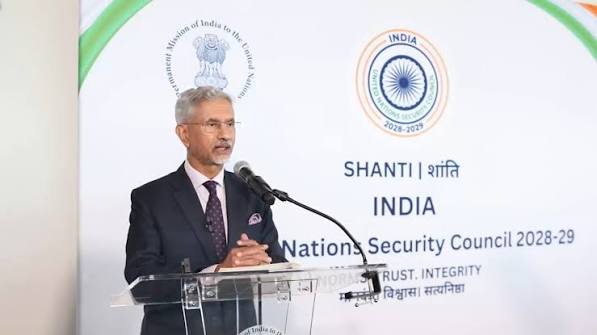
India's formal campaign for a non-permanent seat on the UN Security Council for the 2028–2029 term began on Monday.
India's official campaign, "Shanti: India for the United Nations Security Council 2028-29," was introduced by External Affairs Minister S Jaishankar. UN envoys, diplomats, and officials attended a special event at the UN headquarters titled "Norms, Trust, Integrity" for the two-year term.
"SHANTI: Securing Holistic Advancement through Norms, Trust, Integrity" is the foundation of India's approach to the UN, according to the country, which last sat at the UN horseshoe table for the 2021–2022 term.
India and Tajikistan will compete for the only seat in the Asia-Pacific Group category during the 2028–29 term elections, which are scheduled for June of next year.Later in the day, Jaishankar will also have a meeting with UN Secretary General Antonio Guterres. He arrived in New York over the weekend after making an official trip to Qatar, Bahrain, Kuwait, and Oman from July 5–10. On July 14 and 15, he will leave New York to travel to Brussels for the 3rd India-EU Trade and Technology Council meeting and meet with his Belgian and EU counterparts.
Significant geopolitical changes will occur during the UNSC elections as the globe continues to struggle with issues like the situation in Gaza, the war in Ukraine, and the US-Israeli battle against Iran.In his speech to the Indonesian Parliament last week, Prime Minister Narendra Modi stated that "developing countries like ours are seeking equal participation and a greater role in global affairs" since the world order is changing quickly. India is adamant that reforms in the UN Security Council cannot be postponed in this changing global environment." India, which claims that the 15-nation Security Council, which was established in 1945, is unsuited for its purpose in the twenty-first century and does not reflect current geopolitical realities, has been at the forefront of years-long efforts to reform the Security Council, including expansion in both its permanent and non-permanent categories.Delhi has repeatedly emphasized that it is entitled to a permanent seat at the horseshoe table.
India has demanded that both the permanent and non-permanent categories of UNSC membership be expanded. However, it has warned that if only the non-permanent category of membership is expanded, the UN Security Council reform will be on the verge of "failure" because this will "fundamentally" not alter the five permanent members' decision-making power structure.
India claimed that the "nothing is agreed until everything is agreed" strategy should not be used as a means of impeding progress because the UNSC reform process has been proceeding slowly over the years.India's Permanent Representative to the UN, Ambassador Harish Parvathaneni, stated last month that "status quoists have attempted to use this argument in their favor and thereby, entrench the existing inequities in the Security Council."
.jpg)
.jpg)
.jpg)
.jpg)
.jpg)