
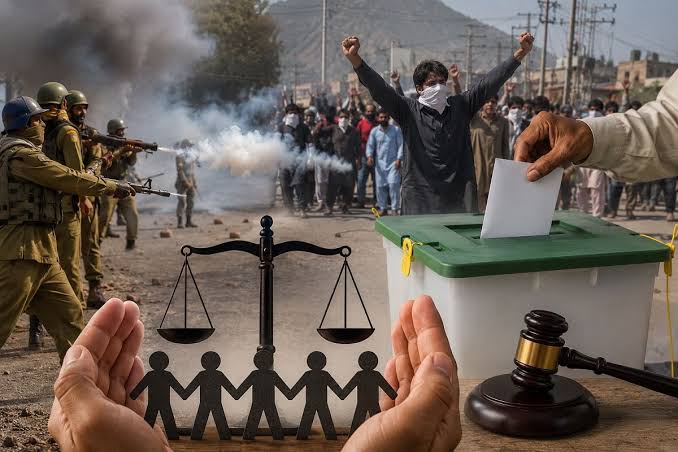
In addition to accusing the government of using "disproportionate force" against demonstrators in PoK, Pakistan's human rights council has expressed grave doubts about the legitimacy of an election process marred by violence and claims of widespread manipulation.
According to a study published on Saturday by the Human Rights Commission of Pakistan's (HRCP) fact-finding mission, long-standing political and socioeconomic grievances, institutional mistrust, and governance deficiencies are the causes of the unrest in Pakistan-occupied Kashmir (PoK).The HRCP stated that "an increasingly confrontational state response, including the disproportionate use of force, has further deepened polarization and eroded public trust," adding that its mission had received starkly contradictory reports regarding the extent of violence and the behavior of security personnel.
The outlawed Joint Awami Action Committee (JAAC), which has been staging protests in PoK since June over the controversial 12 refugee seats, has claimed that the establishment manipulates these seats to appoint a prime minister to head the so-called government in PoK.
On June 5, the Kashmir government banned JAAC under an anti-terrorism statute following the failure of talks between the government and the organization on May 30.
The JAAC claims that during the first round of voting on July 27, more than forty persons were slain.Additionally, it asserts—a charge denied by the federal government—that some 400 protestors have been slain since the first week of June.
The HRCP stated it received numerous stories from families claiming that some protestors had been murdered or gravely injured by the security forces, and it voiced special worry at the claims of "lethal and excessive" use of force against demonstrators.
According to the Kashmir police chief, approximately 38 security personnel have been slain since June.The commission stated, "We were unable to independently establish the full scale or circumstances of civilian casualties, particularly because the team was unable to access Rawalakot, one of the main centers of violence," and demanded an unbiased, independent investigation into all fatalities and serious injuries that have occurred since June, including "whether the use of force was lawful, necessary, and proportionate."
"The report also raised concerns at the government's use of anti-terrorism and preventive-detention provisions against political activists."Regarding the polls in PoK, the HRCP report stated that "wider questions about the credibility of the electoral process were raised by heavy deployment of security personnel, prolonged communications restrictions, boycott by major political actors, phased polling, and postponement of seven constituencies."
According to India, the entire Union Territories of Ladakh and Jammu & Kashmir are essential and unalienable components of the country.Additionally, New Delhi claims that portions of these Union Territories have been under "illegal and forcible occupation" by Pakistan.On August 4, India labeled the so-called local body elections in PoK a "complete farce," claiming that such "hollow" exercises could not conceal the reality on the ground in the area.
The international community should look behind the "flimsy veneer" of Islamabad's "hypocritical lecturing" on human rights, according to the Ministry of External Affairs (MEA), which harshly condemned Pakistan's crackdown on demonstrators in PoK.PoK's purported local election is an absolute farce.
Public demonstrations and wanton executions by Pakistani army are what are actually taking place.At a routine press conference, MEA spokeswoman Randhir Jaiswal stated, "Such hollow exercises cannot hide reality."
According to the HRCP report, cases involving protesters, activists, journalists, and political workers should be independently reviewed. Cases involving people detained or punished for peaceful political activity or lawful assembly should be removed.
Additionally, it criticized limitations on journalism and information access, stating that while independent reporting and verification of deaths, injuries, arrests, and alleged electoral irregularities were severely hampered by the protracted communications shutdown, journalists had faced arrests, legal action, restrictions on access to affected areas, and special security requirements.It stated that the disruption of banking, education, trade, transportation, public administration, and healthcare was caused by the communications blockade, which extended far beyond political activity.
The so-called PoK legislative assembly has 53 seats, of whom 45 are directly elected and eight are set aside for women, technocrats, and clerics.
Seven of the 45 directly elected seats—two in Sudhnoti district and five in Poonch district—were unable to hold elections because of the state of peace and order.
The Pakistan Muslim League-Nawaz (PML-N), led by Prime Minister Shebaz Sharif, now holds 31 of the 46 seats, while the Pakistan People's Party (PPP), its coalition partner at the federal level, holds 14 seats.
A single member of the Awami Dast-o-Bazu Party who won has also joined the PML-N.
Iftikhar Gillani, a PML-N barrister who was beaten by a PPP candidate in the Muzaffarabad-III general election but went on to win a technocrat seat, has been elected as PoK's prime minister.
Nawaz Sharif, the PML-N's founding chair, has come under heavy fire from everyone, including his party members, for choosing a defeated candidate to lead the PoK administration.


