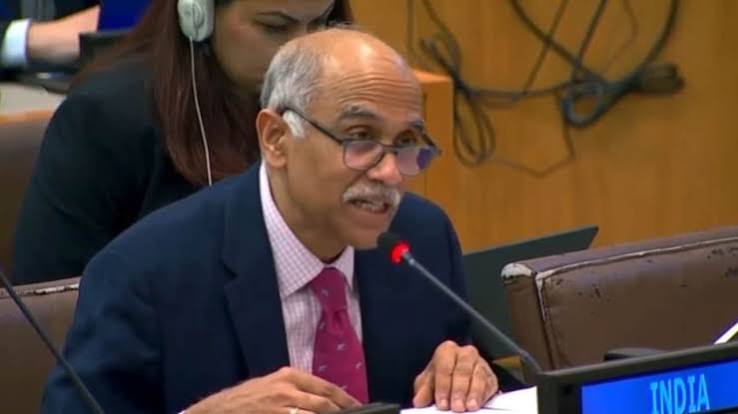
India vehemently denounced conflict-related sexual violence (CRSV) on Thursday, characterizing it as a tactic used in political repression, war, terrorism, and torture to oppress people, quell dissent, and cause misery.
"Today's open debate is on a subject that warrants collective deliberation by member states, particularly in the wake of findings of the UNSG's report on conflict-related sexual violence that corroborates a sharp increase in verified cases in 2025 and the extreme brutality involved," stated India's Permanent Representative to the UN, Ambassador P Harish, during the UN Security Council Open Debate on Conflict-Related Sexual Violence.
In order to subdue communities, quell opposition, and cause human misery, sexual violence is still employed in war, terrorism, torture, and political repression. In the midst of a flourishing culture of impunity, this persists. Such horrible deeds are highly condemned," Ambassador Harish declared.
The deployment of women peacekeepers has had a "transformative impact" in tackling sexual assault associated to conflict, Harish said, highlighting India's historic contributions to UN peacekeeping.According to India's experience, deploying female peacekeepers is a tried-and-true strategy that significantly reduces CRSV.
The UN's first-ever all-female police squad, which India sent to Liberia in 2007, played a crucial role in combating criminality, discouraging sexual and gender-based violence, and assisting in the restoration of public safety and confidence. The Indian envoy pointed out that systems to dissuade CRSV are strengthened by the distinct viewpoint that female peacekeepers bring.
He also declared that the 2026 UN Secretary-General's Military Gender Advocate of the Year Recognition Certificate will be given to Indian peacekeepers Major Moiz Yassin and Major Sonia Devendra Navaskar in recognition of their exceptional work in combating CRSV."In this regard, I would like to draw attention to the work of Major Moiz Yassin, who established an easily accessible, private, and victim-centered channel for informal grievance reporting while serving as UNMIS's force ombudsperson and welfare officer. In addition to creating a force gender database for evidence-based gender-responsive planning, she led more than 40 customized sessions with military observers and nations that sent troops and police," Harish explained.Major Sonia Devendra Navaskar, a member of the UNMIS Gender Task Force and the point of contact for women in uniform, is another example. She developed UNPOL military best practice networks, actively worked toward the intelligence and planning roles for CRSV prevention, and engaged the host country on gender problems.I am pleased to announce that the UN Secretary General has recognized Major Moiz Yassin and Major Sonia for their outstanding work with the 2026 Military Gender Advocate of the Year Recognition Certificate. They're following in the distinguished footsteps of Indian peacekeepers who received comparable honors in 2019, 2024, and 2025," he continued.
.jpg)
.jpg)
.jpg)
.jpg)
.jpg)