At midnight on July 15, the Comprehensive Economic and Trade Agreement (CETA), which aims to increase mutual trade between India and the United Kingdom to $100 billion by 2030, went into effect.
The current trade volume between India and the UK is between $55 and $60 billion. "We hope to reach USD 100 billion within the next three to four years," stated Commerce Secretary Rajesh Agarwal.
According to the agreement, India's exports of textiles, leather goods, shoes, jewelry, and plastics will be allowed to enter the British market duty-free starting on July 15.
According to Darpan Jain, Additional Secretary in the Department of Commerce, sensitive segments, such as small and mid-segment ICE (internal combustion engine) vehicles and reasonably priced EVs, are still protected.Additionally, New Delhi has reduced import taxes on silver from the UK under CETA.
India bought $5.2 billion worth of silver bars from the UK during the 2026 fiscal year, making up 45% of its imports of gold and silver.Conversely, no tariff relief has been granted to gold bars.
Sops for corporate India are also part of the arrangement. For employees who relocate from India, Indian businesses operating in the UK are exempt from paying social security contributions for a maximum of five years.Currently, the UK's National Insurance System receives up to 23% of the entire wage from Indian workers and companies.
According to industry estimates, it will result in $600 million in savings.
"On July 15, 2026, the Double Contribution Convention and the India-UK Comprehensive Economic and commercial Agreement (CETA) came into effect, marking a turning point in India's commercial history. At a press conference in the nation's capital, Agrawal stated, "This is one of the first free trade agreements of its kind, which establishes a future-oriented economic architecture between two major economies of the world."
According to him, the 30 chapters of the agreement cover topics including digital trade, government procurement, small and medium-sized businesses (SMEs), innovation, labor, the environment, and gender.
Indian farmers will have better access to the UK's $90 billion agriculture industry, according to the officer.India's labor-intensive industries stand to gain from the accord since import taxes of up to 12% will be eliminated.According to ANI, Agrawal stated, "Overall, it is a win-win proposition for both sides, with India taking a leap in terms of the extent of market liberalization negotiated and the width of policy areas covered under the agreement."
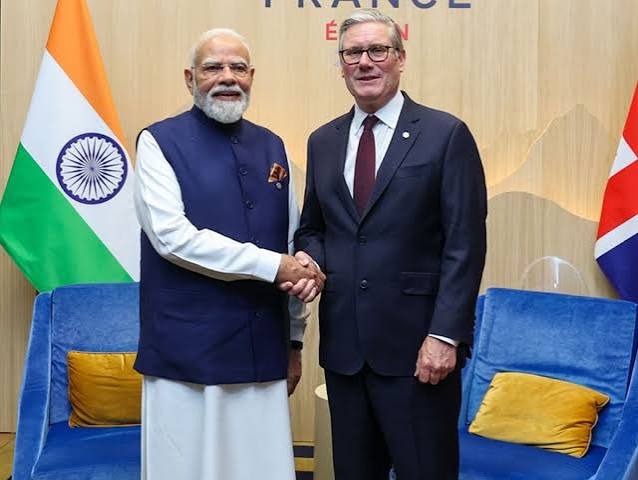
Prime Minister Narendra Modi and British Prime Minister Keir Starmer were present when the agreement was signed in London on July 24, 2025.
.jpg)
.jpg)
.jpg)
.jpg)
.jpg)