
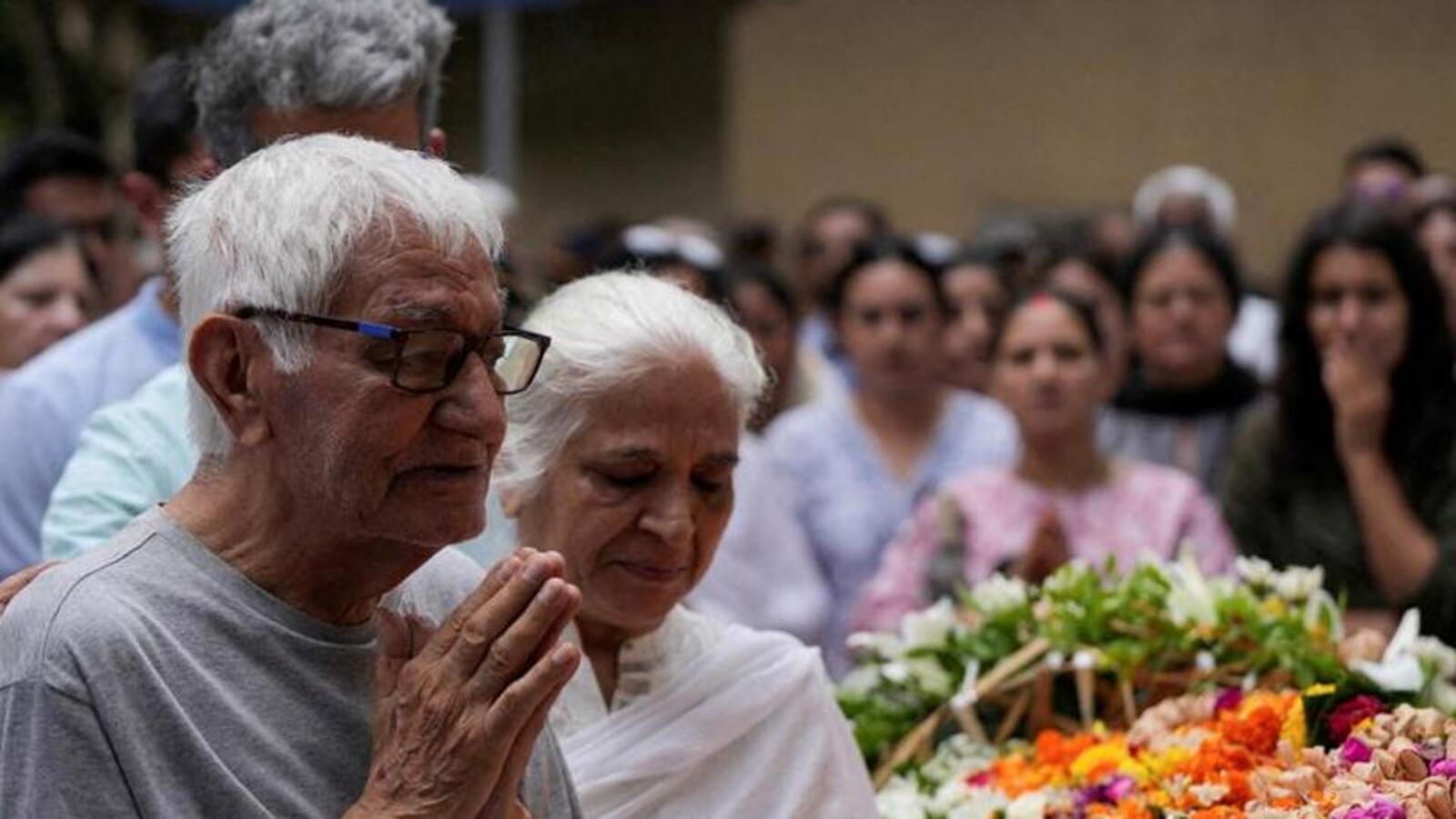
Together with the Federation of Indian Pilots (FIP), the father of the late Captain Sumeet Sabharwal, the pilot of the Air India Boeing 787 Dreamliner that crashed on June 12 shortly after takeoff from Ahmedabad, has petitioned the Supreme Court for a judicially overseen investigation into the incident. Additionally, he has asked the Aircraft Accident Investigation Bureau (AAIB) to conclude its ongoing investigation.
In accordance with Article 32 of the Constitution, the writ petition was filed on October 10 and asks that a committee consisting of independent aviation experts and led by a former Supreme Court judge be established to carry out an impartial and open investigation into the incident.
It claims that the AAIB's preliminary assessment is "defective, biassed, and incomplete" because it ignores important technical and systemic elements that should be examined independently and instead blames pilot error for the tragedy.
The Federation of Indian Pilots (FIP), which represents more than 6,000 pilots, and Capt. Sabharwal's father, Pushkar Raj Sabharwal, have requested that the current investigation be abandoned and that all documents be turned over to a commission under court supervision. It claims that the only way to guarantee accountability, rebuild public trust, and stop such catastrophes from happening again is through an impartial, expert-led investigation.
According to the appeal, Capt. Sabharwal was one of the most seasoned commanders on the Boeing 787 fleet, having flown more than 15,000 hours and without incident for more than 30 years. According to the petition, the current investigation has been biassed against the pilot who died and is unable to defend himself. It further claims that this one-sided investigation not only damages the pilot's reputation but also endangers public safety by failing to determine the actual cause of the crash.
The Ram Air Turbine (RAT), an emergency power generator that kicks in automatically when the primary and backup electrical systems fail, was turned on before the pilots could make any control inputs, according to the appeal, which highlights a number of discrepancies in the preliminary assessment.
The Emergency Locator Transmitter's (ELT) simultaneous failure, which did not activate following impact, was also included in the petition as additional proof of a total electrical collapse.
The report's conclusion that both engine fuel control switches switched from "RUN" to "CUTOFF" in a single second was also contested by the father in the petition, who called the coordinated manual movement "implausible under take-off conditions."
It asserts that rather than intentional pilot action, the sequence is more compatible with an automated or tampered digital command. It is also considered a severe oversight since the flight data recorder's protective case, which was discovered melted and free of soot deposits, was not analysed for damage.
The petition argues that the inclusion of representatives from the Directorate General of Civil Aviation (DGCA), whose regulatory supervision is also being scrutinised, in the five-member AAIB investigative team is a violation of the natural justice principle. It is also noted that the involvement of executives from GE and Boeing, whose technology was used, compromises the probe's objectivity.
The unapproved distribution of cockpit voice recordings to the media in defiance of regulations that forbid the public release of such content is another issue brought up in the petition. According to its allegations, Capt. Sabharwal's right to dignity and repute under Article 21 of the Constitution was violated when selective disclosures resulted in media publications that negatively portrayed him.
.jpg)
.jpg)
.jpg)
.jpg)
.jpg)
.jpg)