
A Leadership Perspective for Enterprise Transformation
Transformation rarely begins in boardrooms. It often starts quietly—in classrooms.
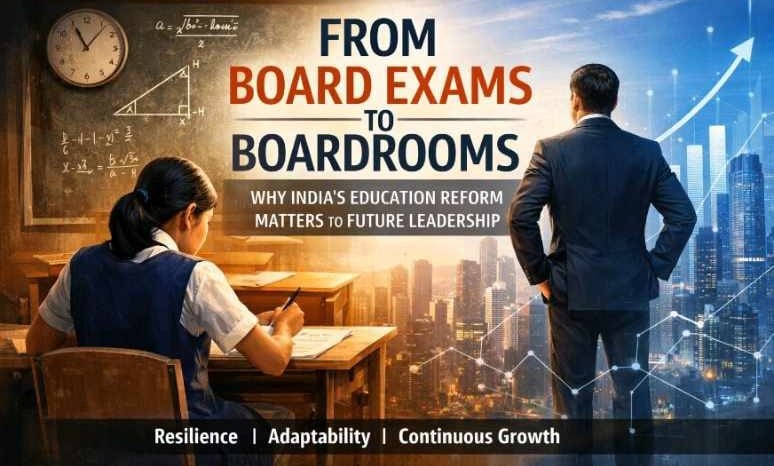
The recent discussions surrounding the CBSE Class 10 Mathematics Examination 2026, where students described the paper as lengthy and demanding, may appear at first glance to be a routine academic debate. Yet, for leaders, policymakers, and enterprise builders, the episode signals something far more significant: India is redefining how performance, resilience, and growth are measured.
Among student reactions, voices like B. Kruthika, a Class 10 student from Sambalpur, Odisha, reflected the evolving nature of assessments—highlighting the need for faster analytical thinking, better time management, and deeper conceptual understanding rather than mere memorisation. Such feedback is not merely academic commentary; it mirrors the competencies demanded in today’s dynamic professional ecosystem.
The Shift from Performance Pressure to Performance Development
For decades, India’s examination system followed a single-attempt evaluation model—high pressure, high stakes, and limited recovery from setbacks. Businesses once operated similarly, measuring employees through annual reviews with little room for iterative improvement.
Modern enterprises have since evolved.
Today’s organizations emphasize:
- Continuous feedback
- Agile performance cycles
- Learning from failure
- Skill-based evaluation
The introduction of CBSE’s two-exam system, allowing students a second opportunity within the same academic year, reflects this same leadership philosophy. It recognizes that capability grows through iteration, not perfection.
Leaders understand a simple truth: one performance moment does not define long-term potential.
Education Reform as a Leadership Signal
Educational frameworks shape workforce behavior years before individuals enter employment. When assessment systems change, leadership culture eventually changes with them.
The emerging education model encourages students to:
- Take calculated risks
- Learn from initial setbacks
- Improve through reflection
- Focus on understanding rather than memorization
These are precisely the qualities organizations seek in future managers, entrepreneurs, and innovators.
In enterprise transformation, adaptability is the new intelligence.
Resilience: The Core Leadership Competency
Student reactions to challenging examinations reveal an important leadership lesson: resilience is developed through structured challenges supported by recovery opportunities.
In business environments:
- Markets fluctuate
- Strategies fail
- Innovation involves uncertainty
Similarly, a challenging exam followed by an improvement opportunity teaches students how to recalibrate performance—an essential leadership behavior.
The message is clear: systems should test capability without punishing growth.
Mental Wellness and Sustainable Performance
Forward-looking organizations increasingly recognize that sustained performance depends on psychological safety and wellbeing.
Education reforms that reduce one-time performance pressure align with the same principle. By offering another opportunity, the system acknowledges human variability—stress, context, and learning curves influence outcomes.
Leaders who understand this build organizations that sustain excellence over time rather than extract short-term results.
Implications for Enterprise Transformation
India’s enterprise ecosystem—especially MSMEs, startups, and digital enterprises—requires professionals who are:
- Problem solvers rather than instruction followers
- Learners rather than memorisers
- Adaptable rather than risk-averse
- Resilient rather than perfection-driven
Education reforms that promote these traits directly contribute to economic transformation.
The classroom is becoming a training ground for future leadership mindsets.
A Lesson for Today’s Leaders
The debate over exam difficulty should not distract from the deeper narrative. The real transformation lies in redefining success itself.
Just as students are now given space to improve within the same academic cycle, organizations must design systems that encourage experimentation, feedback, and continuous capability building.
Leaders must ask:
- Are we evaluating potential or only outcomes?
- Do our systems allow improvement after failure?
- Are we preparing people for certainty—or for change?
Because the future workforce is already being shaped by answers to these questions.
Enterprise Transformation Insight
India’s educational reforms are not merely academic policy adjustments—they are leadership reforms in disguise. As evaluation systems become more flexible and growth-oriented, they cultivate individuals prepared for complexity, uncertainty, and innovation.
Tomorrow’s leaders are not only being trained in management institutes—they are being shaped today in transformed classrooms.
India’s transformation story will not be written only through policies, technologies, or investments—it will be shaped by mindsets. The evolving education system signals a future where learning is continuous, improvement is encouraged, and resilience becomes a foundational skill.
.jpg)
.jpg)
.jpg)
.jpg)
.jpg)