
.jpg)
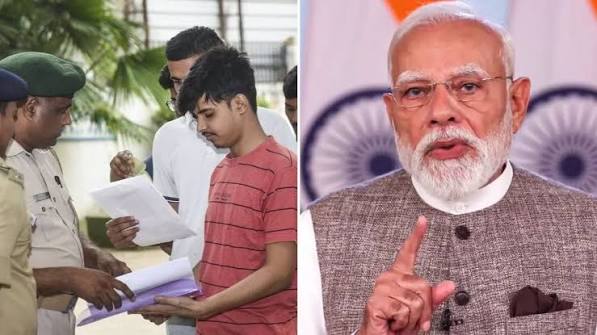
It appeared to be innocuous retail politics when Prime Minister Narendra Modi stopped his 2026 campaign route in rural Jhargram, West Bengal, to joke with a roadside vendor and exchange "jhalmuri" with the local kids. A series of welfare pledges that experts caution bear a hidden fiscal bite of Rs 1.69 lakh crore for state budgets already straining at the seams. The Assembly election results have now revealed something far spicier than puffed rice.
The BJP's election pledge is expected to cost the state exchequer Rs 72,600 crore through cash transfers of Rs 3,000 per month to women and unemployed youngsters, but PM Modi only paid the roadside vendor Rs 10 for his "jhalmuri."
Cash transfers, free power, LPG subsidies, and wedding gold for brides from low-income households are among the additional commitments of Rs 87,900 crore in Tamil Nadu, where newcomer TVK emerged as the largest party in a divided result that drastically deviated from exit polls. Kerala's very small package of social pension increases contributes Rs 8,500 crore to the national total.
"State politics is now firmly anchored in aggressive welfarism, driving persistent expenditure rigidities," cautions Emkay Global's lead economist Madhavi Arora. "Since 2023, election cycles have increased FD/GDP by about 1 percentage point with no reversal, while capex stagnates and revenue spending stays stagnant, pushing out profitable investment. We think the 3% FD/GDP ceiling is essentially turning into the floor.
The market is already expressing unease. In contrast to a 10-year norm of 35–40 basis points, state development loan spreads have expanded to roughly 70 basis points in FY26, indicating investor concern over the state's declining finances. "Party manifestos continue to emphasise higher income transfers and populist schemes; thus, the capex burden will remain with the central government," says Mahesh Nandurkar, equity analyst at Jefferies. The aggregate state deficits for FY26 are tracking at 3.4% of GDP against budgeted estimates of 3.1%, and poll-driven spending is likely to push states past the 3% threshold in FY27 as well.
According to Mahesh Nandurkar, an equities analyst at Jefferies, "Party manifestos continue to emphasise higher income transfers and populist schemes; thus, the capex burden will remain with the central government."
The difficulty is highlighted by the size of each state's promise. TVK in Tamil Nadu has pledged Rs 2,500 per month for women under 60, 200 units of free electricity per month, six free LPG cylinders per household annually, Rs 3,000 per month for social pensions for the elderly, widowed, and disabled, Rs 4,000 per month for graduates without jobs, waivers of cooperative crop loans, and even eight grams of gold and a silk saree for brides from low-income households.
According to Emkay, if these commitments are carried out, they would increase spending by 2.2% of Tamil Nadu's GDP at a time when the state's FY27 budget deficit is already set at 3%.
The figures from West Bengal are considerably more concerning. In contrast to the 2.9% budgeted deficit for FY27, the BJP's decision to double the monthly cash distribution to women from Rs 1,500 to Rs 3,000 alone might result in an added expenditure of up to 3.4% of the state's GDP. The fiscal maths becomes challenging to explain when you include payments of Rs 9,000 to farmers, unemployment benefits, and a 30% increase in paddy minimum support prices over the all-India level.
"Competitive populism has become a mainstay of state level politics," says Nomura analyst Sonal Varma. "There will be pressure on the winners to deliver on these promises, and most of these could worsen the fiscal situation of these states, which already struggle with higher fiscal deficits, debt levels and a predominance of revenue expenditure."
Perhaps more concerning than the promises made by any one state is the structural pattern underlying these figures. Fiscal deficit-to-GDP ratios rise by a full percentage point in election years compared to the previous year, according to data from ten large states that have held elections since 2023, and then remain unchanged the following year rather than improving. Due to what economists refer to as the sticky nature of pre-election welfare obligations, revenue expenditure increased by 0.2 percentage points during election years and by an additional 0.2 points the following year. The most telling finding is that capital expenditure remained constant over the course of the three years, indicating that welfare spending is consistently and directly displacing infrastructure investment.
As Arora notes, "nearly every state had higher FD/GDP in the year after elections versus the year before," demonstrating the challenge of limiting sticky expenditure, with states having to reduce spending elsewhere to minimise deficits. The electoral success of these initiatives means that the race to the bottom will go on.
The longer structural change is highlighted by Radhika Rao, Senior Economist and Executive Director of DBS Bank: "State budgets have witnessed a sharp rise in welfare and populist spending in recent years, structurally lifting deficit ratios past the 3% of GDP threshold in FY26 and likely FY27, also reflected in widening SDL spreads."
There is no denying the political reasoning behind this arms race. With its historic triumph in West Bengal, the third-largest state in India, the BJP has won eight state elections in the last two years, solidifying its hold on power throughout Eastern India. TVK's unexpected performance in Tamil Nadu shows that people can be swayed by extravagant welfare promises, even if they oppose long-standing incumbents. Welfare expenditure creates a ratchet effect that only gets stronger with each triumph it brings about, encouraging the next round of promises.
Investors are not relieved by the electoral schedule. Punjab, Gujarat, and Uttar Pradesh are among the politically significant states that will hold elections in 2027. Given the electoral power of the current formula, there is no reason for any party to blink first. According to Arora, the 3% state fiscal deficit cap "is now the floor" and could soon appear promising.
The outlook is mixed for equities investors, but there are concerns. Widening SDL spreads and ongoing budgetary distress indicate credit pressure and less space for efficient state spending. If there is a bright spot, it is that central government capital expenditures, which are typically the last resort when it comes to infrastructure investment, might sustain prospects in manufacturing, railroads, defence, ports, and industrial electrification.
.jpg)
.jpg)
.jpg)