
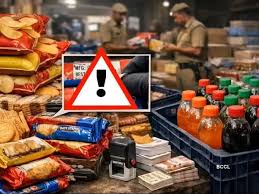
New Delhi: As counterfeit and contaminated goods spread across categories, consumer companies are stepping up their anti-counterfeiting efforts in response to customer backlash and supply and distribution network vulnerabilities. As counterfeiters increasingly replicate cartons, tubes, and even holograms with near-original precision, manufacturers of toothpaste, creams, milk, noodles, and cigarettes, among other products, are regularly changing packaging, tightening supply-chain checks, and educating distributors and retailers, according to industry executives.
"We now often alter the packaging. According to Kedar Lele, president of Haleon (previously GSK Consumer Healthcare), which produces Eno fruit salt antacid and Sensodyne toothpaste, "some of our new packs will now have a layer of raised watermarks of transparent colour on the packaging." "It may not be important for consumers to notice...but my trade teams can identify the packs," he said to ET.
Watermarks are trademarks and company logos that are difficult to replicate.While the issue of counterfeiting and duplication has continued to affect everyday necessities and medications, the regularity with which these occurrences are growing and thriving and being publicised on social media platforms has altered.
Manish Tiwary, managing director of Nestle, stated, "A lot of it is happening not at your factory but at the distributors' level," adding that the company that makes KitKat chocolate and Maggi noodles has greatly increased checks at all levels. "We are a food company. My product cannot just be left in the channel. The food can deteriorate or perish, according to Tiwary.
The Delhi Police Crime Branch tweeted on April 4 about a bogus Sensodyne toothpaste factory, claiming to have discovered thousands of phoney tubes, raw paste, and equipment. "Unhygienic production posed serious health risks to consumers," the social media statement stated.
The national food safety regulator Food Safety & Standards Authority of India (FSSAI) and state authorities frequently raid plants, but the counterfeiting problem is getting worse, pushing businesses to handle their own enforcement, according to executives. Fresh milk and ice cream manufacturer Mother Dairy's managing director, Jayatheertha Chary, stated, "We are establishing new systems of traceability. It's not the same as earlier."
In the current situation, businesses are forced to "educate and do the right things consistently and continuously," he continued. "Now, distributors and retailers understand that social media is very active; they are also afraid; we have stepped up educating them at all levels."
Two months ago, the Indian Railway Catering and Tourism Corporation (IRCTC) called dairy manufacturer Amul after a passenger's complaint about an infestation in a meal provided by an IRCTC caterer went viral on social media.
In a statement, Amul said that the train did not get the batch in issue via its approved distribution network. It went on to say that within its production cycle, such infestation is both operationally and scientifically impossible.Executives pointed out that regardless of the location of the errors, the brand image is jeopardised.
Social media is to blame for the harm. On condition of anonymity, a top executive at a multinational snack manufacturer stated, "Wrong or right, it's my brand that gets the stick." Late last year, 14 wholesalers in Delhi NCR were simultaneously raided by the Korean tobacco brand Esse, which is sold in India through imports by its group firm KT&G, along with their legal partners and enforcement agencies. The company said that the raids "disrupted illegal supply chains and sent a strong message to operators involved in the counterfeit Esse cigarette business," in a statement.

.jpg)

.jpg)
.jpg)