
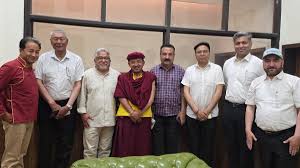
Ladakhi authorities today said that they have come to an agreement with the Center to provide the Union Territory with constitutional protections and a legislature. Following today's meeting with the Center, the decision is the result of a five-year political fight by the locals, who have been calling for Ladakh's statehood and constitutional protections.
After Jammu and Kashmir's special status under Article 370 of the Constitution was revoked and the state was split into two UTs in August 2019, it was created as a distinct Union Territory.
According to a statement released by the Kargil Democratic Front and Ladakh Apex Body, the Center has agreed to give Ladakh constitutional protections "on the lines of Articles 371A, 371F and 371G," which are comparable to those found in Nagaland, Sikkim, and Mizoram, after meeting with representatives from the Ministry of Home Affairs.
The development comes after recent discussions about Ladakh's future political and administrative structure involving members of the MHA, KDA, and LAB.Additionally, the development happened a few weeks after Union Home Minister Amit Shah visited Ladakh and spoke with a number of delegations, including some of these organisations' members. The two organisations representing Ladakh have claimed to have reached an arrangement, although the Center has not yet confirmed this.
The statement claims that following "detailed and constructive deliberations," the parties reached a consensus on a number of important matters. The proposed structure calls for a legislative body at the Union Territory level to grant elected representatives financial, executive, and legislative authority.
They stated that the elected body, which would be led by a chief minister, would have executive responsibility over all Union Territory bureaucrats, including the chief secretary.
According to the two organisations, the talks demonstrated a common dedication to developing a framework for inclusive and sustainable regional governance.
According to the statement, MHA officials clarified that Ladakh's lack of revenue production to cover expenses, like as employee pay, prevented it from being awarded full statehood right once. However, if the Union Territory satisfies the necessary revenue requirements, the proposed structure may eventually open the door to full statehood.
In order to iron out the specific operational aspects of the proposed framework, LAB and KDA stated that they would continue to communicate with the MHA as well as legal and constitutional experts.
Leh originally applauded the August 2019 migration, but it quickly caused widespread dissatisfaction and escalating discontent throughout the region. Together, the Kargil Democratic Alliance and the Leh Apex Body have spearheaded persistent demonstrations since 2021. The creation of a Ladakh Public Service Commission for local employment, inclusion under the Sixth Schedule for tribal protections, full statehood for Ladakh, and increased political representation are their main goals.
In order to interact with LAB and KDA, the central government established a powerful committee and had several rounds of negotiations. But things continued to move slowly. Four individuals were killed and numerous more were injured as protests in Leh descended into violence in September 2025. Tensions in the UT increased as protesters set fire to the local BJP office, sparking altercations with the police and the imposition of a curfew.
.jpg)
.jpg)
.jpg)
.jpg)
.jpg)