
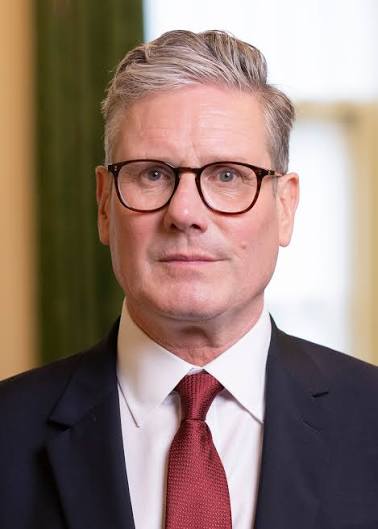
After years of political unrest, Keir Starmer was once hailed as the leader who would bring peace and pragmatism back to Britain. However, the lack of the clear ideological identity that had propelled him to victory ultimately played a role in his demise when he resigned as prime minister on Monday.
Instead of offering a clear vision for Britain's future, Starmer focused on achieving what he thought was possible after leading the Labour Party to victory in 2024 with the biggest legislative majority in modern British history.
More than 20 party insiders said that over time, many voters and Labour members began to perceive him as lacking commitment and a clear sense of purpose. He was thought to lack a distinctive concept.
The former lawyer found himself torn between opposing Labour factions, under pressure from special interests, and misinterpreted by skeptical voters without what one senior Labour lawmaker called "a guiding light." Many of these voters became resentful of what they saw as his indecision and his robotic performances.
His programs frequently fell apart, his team members resigned and were fired, and the trusted aides who were still with him found it difficult to provide the people with a coherent explanation of what his government intended to "change Britain."
For trustworthy guidance, Starmer, 63, increasingly looked to his wife, Victoria. He had a lengthy lunch with her on May 12, five days after Labour's catastrophic local election results sparked calls for him to resign, and came out of it resolved to keep on.
However, the prime minister seems to have changed his mind, accepted the inevitable, and resigned after spending a weekend at his country home at Chequers with his spouse.
He declared on the doorstep of his Downing Street home and office that he would do everything in his power to ensure a smooth transition of power to the next Labour leader, who is likely to be his competitor and former Greater Manchester mayor Andy Burnham.
His voice cracked as he thanked his family for their support. "The question my party is asking now is whether I am best placed to lead us into the next general election," he added in an emotional speech."I have heard the answer from my parliamentary party to that question and I accept that answer with good grace."
By the end, Starmer's popularity had declined due to his broken promises and policy reversals. In private, even some of his closest allies in his top cabinet team of ministers pleaded with him to permit a smooth handover of power instead of a destructive leadership struggle.
After the majority of the party determined they could not run in the 2029 national election under his leadership, his promises to fight to keep his premiership swiftly vanished.
Burnham was now regarded as the "Reform slayer"—the person who had a chance to thwart the populist party of seasoned Brexit campaigner Nigel Farage—after decisively winning an election for a parliamentary seat in northwest England.
The movement to remove Starmer was motivated by fear of Farage. "I would do anything to stop Farage," stated legislator Catherine West, who broke cover over the weekend of May 9–10 in an attempt to compel others to oppose the prime minister.
This is not how it was supposed to be.Burnham was now regarded as the "Reform slayer"—the person who had a chance to thwart the populist party of seasoned Brexit campaigner Nigel Farage—after decisively winning an election for a parliamentary seat in northwestern England.
Starmer, a 52-year-old Labour legislator who joined the party in 2015, was elected leader five years later. The party had its worst election performance since 1935 under his predecessor, veteran left-winger Jeremy Corbyn, who was plagued by charges of antisemitism and a fudged Brexit stance.
He attempted to modernize the Labour Party and eventually make it more electable by drawing on his experience managing the Crown Prosecution Service, an independent organization that counsels law enforcement and prosecutes criminal cases in court.
"Everything we offer will be built on a bedrock of economic stability and a plan for growth," his representative stated at the time.
At first, it was successful. In Britain's 650-seat parliament, his newly reformed Labour earned a sizable majority, but experts quickly noted that the party's triumph was precarious—Labour actually received one of its lowest vote shares ever, and the victory was heavily reliant on tactical voting.
The Conservatives had virtually destroyed themselves as a party after 14 years of internal strife, Brexit disputes, and five prime leaders in eight years.
The most well-known pollster in Britain, John Curtice, stated that "all in all this looks more like an election the Conservatives lost than one Labour won."One member of his top opposition team claimed that Labour was simply unprepared for government, citing an instance in which they attempted to formulate policies but were instructed to "stop" in order to avoid "frightening people in advance of the general election."
"We don't have a plan for what we're going to do when we get in, if we do get in, because it might jinx it," the individual said.
As the months passed, Starmer made an effort to highlight the accomplishments of his administration, such as bettering working conditions, cutting waiting lists for health services, and managing an atmosphere that allowed borrowing rates to be lowered.
Instead, despite Peter Mandelson's acknowledged ties to the late convicted U.S. sex offender Jeffrey Epstein, voters were unable to look past gaffes over donations, policy reversals, and his appointment.
Many felt that Starmer was, at best, out of touch and, at worst, out of control of his administration because of his defense that he was unaware of the full extent of Mandelson's connections to Epstein. "It was a bad appointment," one former aide said, implying that only two other former advisers had pushed it through.The end of the Starmer government was marred by a blame game.There was an increasing sense of discontent in his Downing Street office.
After one reset after another, Starmer finally failed to show "his passion for these domestic causes," as one adviser put it. Some aides blamed this on what they dubbed hostile right-wing media.
The Mandelson controversy caused him to lose some of his closest advisers, including his former chief of staff Morgan McSweeney, and his relationship with Britain's civil service deteriorated after he fired the top officer at the foreign office.On the international scene, Starmer performed better.
Regarding Russia's war against Ukraine, he was commended by several other European leaders for leading the "coalition of the willing" of countries prepared to assist in the case of a peace agreement. He also led negotiations to reopen the Strait of Hormuz alongside French President Emmanuel Macron.
After one reset after another, Starmer finally failed to show "his passion for these domestic causes," as one adviser put it. Some aides blamed this on what they dubbed hostile right-wing media.
The British leader was also somewhat successful in winning over U.S. President Donald Trump, frequently by stroking his ego by promising him a second state visit to Britain and commending his efforts to settle other wars and bring about peace in Ukraine.
After Starmer declined to enlist Britain in the war against Iran, the U.S. commander quickly replaced it with a barrage of disparaging remarks about him, claiming he was no Winston Churchill. "Keir Starmer will resign as Prime Minister of the United Kingdom," Trump said on Truth Social on Sunday.
After one reset after another, Starmer finally failed to show "his passion for these domestic causes," as one adviser put it. Some aides blamed this on what they dubbed hostile right-wing media.
The disintegration of Britain's established two-party system may be his most enduring legacy.
The parliamentary elections in Scotland and Wales, as well as the local elections in England, demonstrated that the country's long-standing two-party system had been completely overthrown by Reform.
Reform's membership increased to almost 270,000, while Labour's declined. Starmer had told his Labour Party in February that the struggle against Reform was the "fight of our lives" and had believed that this threat would secure his support.He lost the battle in the end.
.jpg)
.jpg)

.jpg)
.jpg)
.jpg)