
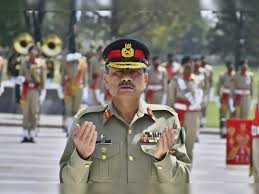
In order to guarantee better coordination and unified command among the three services, Pakistan proposed a constitutional amendment on Saturday that would establish a new position of head of defence forces.
The proposed amendments to Article 243 of the Constitution, which addresses the armed forces among other matters, are part of the 27th Constitutional Amendment bill.
The President will select the Chief of Defence Force and the Chief of Army on the Prime Minister's recommendation under the amendment bill.
The head of the National Strategic Command will be chosen in conjunction with the Prime Minister by the Chief of Army Staff, who will also serve as the Chief of Defence Forces. It further states that a member of the Pakistan Army will lead the National Strategic Command.
The government will have the authority to elevate members of the armed forces to the positions of Admiral of the Fleet, Marshal of the Air Force, and Field Marshal. Field Marshals will hold their position and benefits for the rest of their lives.
According to the bill, the position of Chairman of the Joint Chiefs of Staff Committee will end on November 27, 2025.
The action is reportedly motivated by lessons learnt from the four-day battle between Pakistan and India in May as well as the changing nature of modern warfare, which necessitates synchronised operational response, according to a Friday local media report.
Operation Sindoor, which targets extremist infrastructure in Pakistani-controlled areas, was initiated by India on May 7 in reaction to the terror assault in Pahalgam on April 22. Four days of fierce fighting followed the strikes, and on May 10, an agreement to halt military operations was reached.
Last month, Air Chief Marshal A P Singh said that Indian strikes had destroyed or damaged at least a dozen Pakistani military aircraft, including F-16 aircraft of US provenance.
India has maintained that following the Indian military's bombardment of many Pakistani military facilities in May, Pakistan begged for an end to hostilities.
Army Chief General Asim Munir became the second highest ranking military official in Pakistan's history when the government upgraded him to the rank of Field Marshal shortly after the war.
In addition, the 27th Constitutional Amendment bill would alter the bar for provincial cabinets, alter the procedure for selecting high court judges, and establish a Federal Constitutional Court.
Hours after the law was agreed by the cabinet, Law Minister Azam Nazeer Tarar introduced it in the Senate, the upper house.
According to Tarar, there were 49 clauses in the measure. To be clear, there are two ancillary areas and three primary areas. It will cover five topics," he stated.
The measure was forwarded to the Standing Committees on Law and Justice for assessment and discussion by Senate Chairman Yousuf Raza Gillani.
He stated that the report would be put to the House and that both committees might convene jointly for a thorough assessment and consideration.
Ali Zafar, the leader of the opposition Pakistan Tehreek-e-Insaf (PTI), stated that discussing the constitutional revision was inappropriate while the opposition leader's job was still open.
He claimed that there seemed to be a rush to pass the law by the government and its allies.
He proposed that the bill be discussed by all members of the Senate, saying, "I would suggest that instead of sending it to the committee, let this Senate be treated as a committee as a whole."
The PTI leader added that the opposition had not yet read a word of the text and had only received it on Saturday.
He declared, "We cannot debate something we have not read."
According to state-run PTV News, Prime Minister Shehbaz Sharif had presided over the cabinet meeting via video link from Azerbaijan just prior to the Senate session.
It further stated, "The federal cabinet fully welcomed and approved the draft for the 27th Constitutional Amendment."
.jpg)
.jpg)

.jpg)
.jpg)
.jpg)