
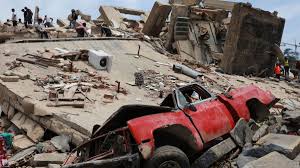
Following two significant earthquakes that killed at least 235 people, desperate Venezuelans hurried on Thursday to locate and save loved ones who were trapped alive beneath the debris of collapsed buildings.
Within minutes of each other on Wednesday night, two earthquakes with magnitudes of 7.2 and 7.5 struck northern Venezuela, causing buildings to crack, crumble, and tilt dangerously.
Health Minister Carlos Alvarado said the death toll had increased from 188 to at least 235, and strong aftershocks could still be detected on Thursday.
In what many Venezuelans described as a horrifying demonstration of nature's sheer force, the earth roared and rocked, injuring over 1,500 people.Time was running out for some of the injured and trapped, and rescue operations proceeded slowly, with bodies still visible behind wreckage hours after the earthquakes.
Residents of a city in the hardest-hit state of La Guaira, north of Caracas, listened helplessly for hours while a small girl called out for assistance.Resident Dani Rizo, 48, stated, "We need people... military personnel to come and help so we can get her out."
The girl passed away shortly after, locals said AFP.
Three persons could be heard among the debris of a collapsed structure somewhere else in La Guaira.They're still alive... Antonio Bermudez, a resident, stated, "There's nothing more we can do." "We have no tools. We are unable to assist.Speaking on condition of anonymity, a physician at the city's Domingo Luciani Hospital reported that children were being retrieved from the debris and arrived in ambulances by themselves.While some kids show up with identification tape on their arms, others give their names," he said.
International rescue teams are en route
Speaking off the record, a rescue worker told AFP that there were serious technological issues and a lack of skilled personnel, making the situation unstable.
La Guaira was designated a "disaster zone," and on Thursday, interim president Delcy Rodriguez paid a visit.AFP reporters saw locals pillaging a nearby grocery.
Nicole Kast, the International Rescue Committee's (IRC) director for Venezuela, called the situation "catastrophic."
Worldwide offers of assistance flooded in; among those sending experts and rescue teams to Venezuela were Switzerland, Spain, France, Portugal, and Mexico.
The US announced that it was mobilizing $150 million in help and dispatching two warships, transport aircraft, and helicopters.The entire government is responding. It will be large, quick, and successful," stated US Secretary of State Marco Rubio.
After US soldiers overthrew and detained President Nicolas Maduro in January, Washington became deeply involved in the oil-rich nation of Venezuela.Pope Leo XIV has sent the nation an initial 100,000 euros in aid, while China, India, Brazil, and even war-torn Iran have offered assistance.
As the international organization promised to support Venezuela, UN leader Antonio Guterres expressed his "deeply saddened" feelings over the catastrophe.
The largest earthquake to strike Venezuela in 126 years would necessitate "massive collective efforts," according to a statement from UN relief chief Tom Fletcher.
The international airport in La Guaira has been closed due to significant damage, which might impede rescue efforts.Officials from both nations stated that among the dead were citizens of Portugal and Italy.
Tremors in Brazil and Colombia
Despite being situated on a tectonic plate border between the Caribbean and South America, Venezuela's northern coast has not seen a major earthquake since 1997, which claimed 73 lives. In 1967, another earthquake claimed 236 lives.
The strongest earthquake since a 7.7-magnitude tremor offshore on October 29, 1900, was the 7.5-magnitude one that occurred on Wednesday.
Bogota citizens evacuated buildings as a precaution after the earthquake was felt in neighboring Colombia.
The nation's seismic monitoring network also reported tremors in a number of northern Brazilian cities.
In the capital city of Caracas, scenes of terror and devastation also occurred, with many people sleeping on the streets or in their cars during the night.
.jpg)
.jpg)

.jpg)
.jpg)
.jpg)