
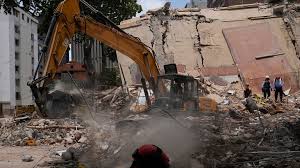
As a desperate and sluggish search for survivors was bolstered by foreign rescue teams, the dead toll from the twin earthquakes in Venezuela increased to 920 on Friday. Tens of thousands of people were reported missing.
As anger over the apparent lack of an official reaction grew, Caracas people mocked interim leader Delcy Rodriguez during her visit to a destroyed area.
More than 50,000 people were reported missing, according to UN relief chief Tom Fletcher, who told AFP that two strong earthquakes that occurred within a minute of one another on Wednesday night destroyed structures in the country's north.
The worst affected area was the seaside region of La Guaira, which is close to the capital Caracas. The magnitude 7.2 and 7.5 earthquakes caused one building after another to collapse.In a televised speech on Friday, Interior Minister Diasdado Cabello declared that access to the disaster area will be restricted starting at 8 p.m. local time (0000GMT).
One residential complex in La Guaira, consisting of four tall buildings housing hundreds of units that had mostly been reduced to rubble, was reached by a Chilean rescue team.Sadly, there is little possibility of discovering survivors because the collapse is complete. At the location, which is similar to many others in the city, rescue team commander Nadiomar Polanco stated that efforts are now concentrated on recovering the bodies of the deceased.
In other places, relatives, neighbors, and volunteers dug out survivors with their bare hands while lamenting the absence of heavy equipment or official assistance to save those who were trapped alive.
"I am looking for my little Gael... he was only five months old," a distraught 40-year-old Marjosly Salazar, whose 16-year-old daughter perished in the earthquake, said. Both Salazar's cousin and the infant are absent.We need your help, please. To begin lifting the columns, we need machinery," she stated. "We haven't seen any government officials here, none at all."
Rodriguez was confronted by irate chants from a group of people whose loved ones were buried beneath the rubble in a posh Caracas neighborhood.They shouted from behind cordons close to a crushed building, "The government isn't doing anything for the people.""Very Complex"
AFP observed workmen breaking through debris with sledgehammers while requesting "absolute silence" in order to hear survivors' cries.The UN's Fletcher told AFP, "It's a very, very complex emergency response," cautioning that the death toll might grow sharply.
There were still serious risks from aftershocks and demolished structures
After more than ten years of economic collapse that destroyed hospitals and public services and forced millions of people to flee the nation, oil-rich Venezuela is now experiencing its biggest earthquake in almost a century.Six months after the US overthrew leader Nicolas Maduro, the nation is still in a precarious transition.
Assistance Arrives
Search and rescue teams from at least 17 nations are being recruited to aid in the search for survivors, according to the UN humanitarian organization OCHA.
Rescue crews from Mexico, Colombia, Switzerland, Spain, and El Salvador had already arrived.To supervise Washington's assistance efforts, a top US military officer arrived in Caracas.
A disaster response team of around 250 people, including three special search-and-rescue squads with dogs trained to find anyone trapped beneath the debris, will be sent by the United States, the country announced on Friday.Millions of Venezuelans faced food insecurity, deteriorating health care, threats to their safety, and restricted access to essential services even prior to the earthquakes, according to a statement released on Friday by the UN and other relief organizations.
Killed Foreigners
Nine Portuguese, five Spaniards, two Brazilians, two Chinese, and one Italian-Venezuelan were among those slain.
The governments of Portugal and Spain reported that 56 Portuguese people and 133 Spaniards were missing or otherwise unaccounted for.
Since a 7.7-magnitude earthquake that occurred offshore in 1900, the earthquakes were the strongest to strike Venezuela.
Despite being situated on the border between the Caribbean and South American tectonic plates, Venezuela's northern coast has not seen a significant earthquake since 1997.
The World Cup 2026 matches on Friday were preceded by minutes of silence in remembrance of the tragedy's victims.
.jpg)
.jpg)

.jpg)
.jpg)
.jpg)