
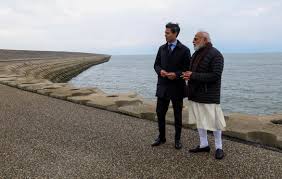
Following Prime Minister Narendra Modi's diplomatic visit to the Netherlands, Gujarat's ambitious Kalpasar Project has made significant strides. PM Modi visited the Netherlands and examined the famous Afsluitdijk water management system with Dutch Prime Minister Rob Jetten. PM Modi was impressed by the engineering and pointed out that, given the obvious similarities between the Dutch construction and the projected Kalpasar Project, Gujarat can learn important lessons from the technology utilised in the 32-kilometer barrier dam.
The Netherlands' Ministry of Infrastructure and Water Management and India's Ministry of Jal Shakti signed a Letter of Intent to formalise this technical exchange. By utilising Dutch engineering expertise, the partnership creates direct technical cooperation for the Kalpasar Project with the goal of accelerating its implementation. This collaboration expands on the India-Dutch Strategic Partnership on Water, which was formed in March 2022 and gives India access to more than 90 years of Dutch experience in flood management and marine dam construction.
Originally conceived during PM Modi's time as Gujarat's chief minister, the Kalpasar Project aims to build a large dam across the Gulf of Khambhat. Seven rivers that currently empty into the sea will have their waters impounded by the project, creating a sizable freshwater reservoir.By reducing the dangers of depending only on the Sardar Sarovar Dam and guaranteeing greater access to water for cultivation and drinking in drought-prone areas, the project is intended to offer long-term water security.
Due to serious marine engineering issues, the project's implementation has been delayed for a lengthy time. However, new momentum has been supplied by recent bilateral events. Bhupendra Patel, the chief minister of Gujarat, met with Marisa Gerards, the ambassador of the Netherlands, in Gandhinagar towards the end of March to explore the creation of an Indo-Dutch expert group to address these issues. In the project's full study, it is noteworthy that the international maritime engineering institution Royal Haskoning has already contributed to the development of the crucial closure methodology needed for the dam.
The multipurpose project is anticipated to irrigate roughly 10 lakh hectares of land spread across 42 talukas in nine Saurashtra districts once it is finished. In addition to providing water security, the dam will facilitate transportation, cutting the 240-kilometer trip between South Gujarat and Saurashtra down to just 60 kilometres. Along with increasing local fisheries and tourism, the facility is also expected to produce 1,500 MW of wind energy and 1,000 MW of solar energy.
.jpg)
.jpg)

.jpg)
.jpg)
.jpg)