
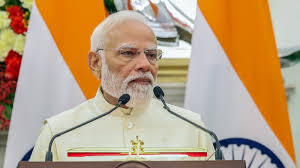
Prime Minister Narendra Modi on Sunday urged Swedish businesses to increase their presence in manufacturing, renewable energy, green hydrogen mission, and other areas, claiming that India's "reform express" is moving at full speed.
In an attempt to win over European businesses, Modi emphasised the potential in five key areas, such as digital infrastructure and telecom, and said that they might assist India in becoming a global center for research and development.
The prime minister also urged cooperation in the fields of electronics, deep tech manufacturing, artificial intelligence, green energy, infrastructure, mobility, urban transformation, healthcare, and life science.Speaking to the European Round Table for Industry (ERT) during an official visit to Sweden, Modi emphasised that all businesses have opportunities and promised that a number of measures, including the establishment of an institutional framework, can be implemented so that they can participate in India's flagship projects in the years to come.
He pointed out that India should co-create the next wave of technological innovation.India has been working on the fundamental tenet of reforms, performance, and change for the past twelve years. At the discussion, Modi emphasised the nation's youthful population, growing middle class, and infrastructural development. "And with the government's political will, this Reform Express is moving forward at full speed," he remarked.
Modi urged for fusing Sweden's capabilities in innovation and sustainability with India's size, talent, and growing momentum, highlighting the shared principles of democracy, transparency, innovation, and sustainability between the two countries.
Ulf Kristersson, the prime minister of Sweden, Ursula von der Leyen, the president of the European Commission, prominent European business executives, and representatives from top European and Indian corporations all took part in the roundtable organised by the Volvo Group.
Modi praised the successful conclusion of negotiations for the historic India-EU Free Trade Agreement (FTA) and the increasing momentum in India-EU relations in his speech.
He hailed the deal as a transformative economic alliance that will open up new business prospects in manufacturing, services, commerce, technology, and robust supply chains.At the governmental level, we have established a bold and strategic objective. This is the mother of all bargains, as Ursula von der Leyen once stated. We're working to put this into effect as quickly as we can," he stated.
India and the European Union (EU) signed the free trade agreement (FTA) in January.Additionally, he pointed out that connectivity initiatives like the India-Middle East-Europe Economic Corridor (IMEC) enhance the business ties between Europe and India.
Modi emphasised that India is currently among the most desirable places in the world for industry, innovation, and investment.He emphasised India's next-generation economic reforms, ease of doing business, emphasis on governance, growing digital public infrastructure, thriving manufacturing environment, and quickly evolving infrastructure sector.
In addition to inviting European businesses to strengthen their ties with India as a dependable and trustworthy economic partner, Prime Minister Modi reaffirmed India's objective of "Design for India, Make in India, and Export from India."
Additionally, he emphasised the significance of skill alliances, education, and talent mobility between Europe and India. He underlined the need of strengthening interpersonal relationships and innovation partnerships while highlighting India's youthful and talented workforce as a key asset for future global economic growth.The prime minister proposed establishing an India Desk at ERT and conducting an annual roundtable of CEOs from India and Europe.
In addition to reaffirming India and Europe's shared commitment to sustainable growth, technological cooperation, and durable global relationships, the interaction offered a crucial forum for exchanging ideas on enhancing India-European economic and industrial cooperation.
Modi also spoke with a few Swedish CEOs, as did Prime Minister Kristersson and Crown Princess Victoria of Sweden.According to a statement from India's external affairs ministry, Modi emphasised during the meeting that Sweden and India share values of democracy, transparency, innovation, and sustainability, which offer a solid basis for an ambitious and forward-looking economic partnership.
He emphasised that the current India-Sweden collaboration is a partnership of ideas, technology, innovation, and co-creation rather than just an economic one.
He applauded the longstanding commitment of Swedish businesses to India's development and promoted closer cooperation in manufacturing, research, innovation, and the green transition.
Through programs like "Make In India," the National Green Hydrogen Mission, and the National Critical Mineral Mission, the prime minister encouraged Swedish businesses to expand their footprint in India.
Additionally, he discussed growing prospects in fields including sophisticated manufacturing, military, clean energy, and semiconductors.
Strengthening collaboration in resilient supply chains, the green transition, sustainable mobility, life sciences, and digital technologies were among topics of discussion.
According to the announcement, Modi emphasised the significance of fusing India's size, talent, and rising momentum with Sweden's strengths in innovation and sustainability to jointly develop solutions for the twenty-first century.
Modi emphasised that both Sweden and India are attempting to establish a long-term economic alliance that goes beyond the buyer-seller relationship.
.jpg)
.jpg)
.jpg)
.jpg)
.jpg)