
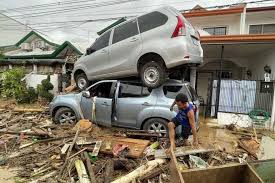
Following Typhoon Kalmaegi, the biggest natural disaster to strike the Philippines this year, which left at least 114 people dead and hundreds missing in central regions, Philippine President Ferdinand Marcos Jr. proclaimed a state of emergency on Thursday.
The majority of the fatalities were caused by drowning in flash floods, and 127 people remained unaccounted for, many of them in the severely affected central province of Cebu. On Wednesday, the tropical cyclone left the archipelago and entered the South China Sea.
Nearly 2 million people were impacted by the typhoon's onslaught, and over 560,000 villagers were relocated, including nearly 450,000 who were taken to emergency shelters, according to the Office of Civil Defence.
During a meeting with disaster-response experts to evaluate the typhoon's effects, Marcos declared a "state of national calamity," which would enable the government to distribute emergency money more quickly and avoid food hoarding and overpricing.
Disaster response officials cautioned that another tropical cyclone from the Pacific might intensify into a super typhoon and batter the northern Philippines early next week, while they continued to deal with the fatal and devastating effects of Kalmaegi in the country's centre area.
Six persons were killed when a Philippine Air Force helicopter crashed in the southern province of Agusan del Sur on Tuesday; officials have ascribed these deaths to Kalmaegi.
According to the military, the crew was its route to deliver humanitarian aid to provinces that had been devastated by the storm. The crash's cause was not disclosed.
In the province of Cebu, Kalmaegi triggered flash floods and caused a river and other waterways to rise. According to provincial officials, the ensuing floods overtook residential communities, prompting residents to climb on their roofs where they frantically begged to be saved as the floodwaters surged.
According to the Office of Civil Defence, at least 71 persons in Cebu died, primarily from drownings, while 65 more were reported missing and 69 were injured.
In the central province of Negros Occidental, which is close to Cebu, 62 more people were reported missing.
Cebu Governor Pamela Baricuatro told The Associated Press over the phone, "We did everything we could for the typhoon, but, you know, there are really some unexpected things like flash floods."
According to Baricuatro, poor flood management initiatives in Cebu province and years of quarrying that clogged neighbouring rivers and caused them to overflow may have exacerbated the issues.
In recent months, street protests and public indignation have been triggered by a corruption scandal involving inadequate or nonexistent flood control projects around the Philippines.
On September 30, Cebu was still recuperating from a 6.9-magnitude earthquake that killed at least 79 people and forced thousands of others to flee their homes due to catastrophic damage or collapse.
Before the typhoon hit, thousands of people in northern Cebu who had been affected by the earthquake were relocated from flimsy tents to stronger evacuation shelters, according to Baricuatro. She noted that majority of the floods caused by Kalmaegi did not affect the northern communities that were affected by the earthquake.
More than 3,500 passengers and cargo truck drivers were stranded in almost 100 seaports due to the Coast Guard's ban on ferries and fishing boats going out to increasingly choppy waters. There were at least 186 domestic flight cancellations.
About 20 typhoons and storms hit the Philippines every year. The nation is among the most disaster-prone in the world because it frequently experiences earthquakes and has over a dozen active volcanoes.
.jpg)
.jpg)

.jpg)