
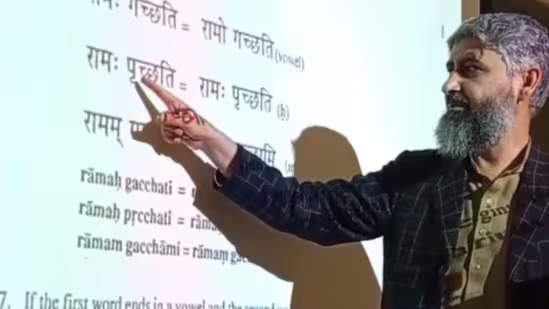
Sanskrit is being taught in Pakistani classrooms for the first time since Partition. A four-credit course in the classical language has apparently been created by the Lahore University of Management Sciences (LUMS), which is a rare institutional attempt to revitalise Sanskrit studies in the nation.
Dr. Shahid Rasheed, an Associate Professor of Sociology at Forman Christian College who has studied Sanskrit for years, is largely responsible for the increased interest in the language.
"Mankind can learn a great deal from classical languages. I learnt Sanskrit after first understanding Arabic and Persian," Dr. Rasheed told The Tribune. He also mentioned that he learnt a lot from internet resources.
The study of classical Sanskrit grammar took nearly a year. He said, "I'm still studying it."
Students and academics were very interested in the course, which developed from a three-month weekend workshop.
Pakistan has one of the richest but least studied Sanskrit collections in the region, according to Dr. Ali Usman Qasmi, Director of the Gurmani Centre at LUMS. He cited the extensive collection of palm-leaf manuscripts in the Punjab University library in an interview with The Tribune.
researcher JCR Woolner catalogued a sizable collection of Sanskrit palm-leaf manuscripts in the 1930s, but since 1947, no Pakistani researcher has worked with this collection. It is only used by researchers from other countries. That will change if scholars are trained locally, he said.
"It is also ours."
Dr. Rasheed stated that people frequently ask him why he chose to study Sanskrit, a language that is frequently used in Hindu sacred scriptures.
"Why shouldn't we learn it?" I ask them. It serves as the region's unifying language. This was the village of the Sanskrit grammarian Panini. During the Indus Valley Civilisation, a lot of writing was done here. Sanskrit is a cultural landmark, much like a mountain. We must take responsibility for it. He told the English newspaper, "It is ours too; it's not tied to any one particular religion."
Wider cross-border interaction with classical languages, according to Rasheed, could change regional ties.Language as a link rather than a barrier
Dr. Rasheed's journey is given a more intimate touch in a different piece published by ThePrint. According to the 52-year-old scholar, language is "a bridge" that starts at home and is based on shared history. His daughter, who is now proficient in the Devanagari script, was his first pupil.
According to ThePrint, he can trace his family back to a village in Karnal, and one of his grandparents was from Sheikhpura in modern-day Uttar Pradesh. These ties serve as reminders of a common civilisational environment that is separated by politics and boundaries.
"I was drawn to Devanagari. According to ThePrint, he recalled, "It is so artistic, I found it profound."Course plans for the Gita and Mahabharata
A single course is not the end of the initiative. Dr. Qasmi says the institution intends to add structured studies of the Bhagavad Gita and the Mahabharata to its list of offerings.
He told The Tribune, "We could see scholars of the Gita and the Mahabharata based in Pakistan in ten to fifteen years."
Students are also exposed to cultural content related to Sanskrit literature as part of the Sanskrit program, such as the Urdu version of the famous theme song from the television series Mahabharat, "Hai katha sangram ki."
.jpg)

.jpg)
.jpg)