
.jpg)
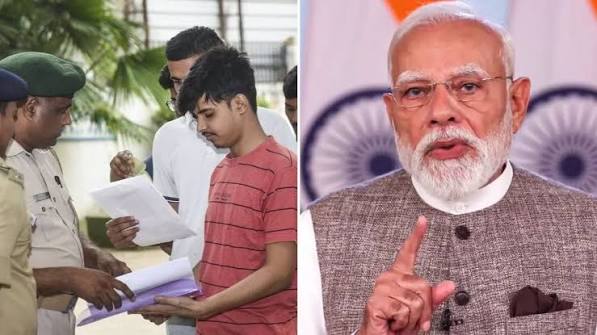
The Trinamool Congress' 10-page notice for the removal of Chief Election Commissioner Gyanesh Kumar, also known as the impeachment motion, cites seven key points, including the large-scale deletion of voters' names in Bihar and Bengal during the Special Intensive Revision of voter rolls, the CEC's biased attitude toward certain political parties, and misbehaviour. Gyanesh Kumar is the first CEC to get notice of such a motion.
The Trinamool Congress took the initiative in launching impeachment proceedings, as part of a pact that included offering support to the Congress's no-confidence move against the Speaker. Signatures were collected only after the Congress and the entire opposition reached an agreement at a meeting of the INDIA bloc.
A notice of impeachment requires the backing of 100 Lok Sabha members and 50 Rajya Sabha members; however, the notice submitted by the Trinamool Congress had the signatures of 130 Lok Sabha members and 63 Rajya Sabha members.
What's Next
If the notice appears to be in order, and there is sufficient evidence to support the move, the Speaker and Rajya Sabha Chairman will constitute a joint committee.
Rules require the formation of a three-member committee consisting of a Supreme Court Judge, a Chief Justice of a High Court, and a prominent lawyer or notable jurist.
The committee will be tasked with conducting a preliminary investigation into the charges and providing a judgment on whether a "prima facie" case for impeachment exists.
The Impeachment Procedure
The procedure for removing the Chief Election Commissioner (or other Election Commissioners) is the same as that of a judge.
Article 124(4) of the Constitution specifies how a Supreme Court Judge can be removed from office. According to the Article, a judge may be removed exclusively on two grounds: Proven misbehaviour and inability to carry out their job.
The Numbers Hurdle
Passing such a resolution requires a "special majority," which means at least 50% of the House's total membership. Furthermore, one-third of the members present and voting at the time must agree.
The impeachment motion is expected to be lost in whichever House it is introduced in, as the Opposition currently lacks the numbers to establish a special majority in either House.
The Chief Election Commissioner will be able to hire legal counsel to submit his defence before the House.
The Precedent
A precedent for this can be found in Indian parliamentary history: during the impeachment hearings of Justice V Ramaswami in 1993, a separate dock was built within the Lok Sabha chamber from which Advocate Kapil Sibal made arguments in his defense.
However, Justice Ramaswami resigned shortly following the debate.
This approach was used in the case of Justice Yashwant Varma in relation to the cash row.First, what about the Justice Varma case?
The Lok Sabha Speaker has already appointed a three-member committee to investigate the impeachment motion stemming from the discovery of burned cash notes at Justice Yashwant Varma's apartment.
This group, which includes Supreme Court Justice Aravind Kumar, Bombay High Court Chief Justice Chandrashekhar, and top Karnataka High Court attorney BV Acharya, is currently analyzing the matter.
The Speaker constituted the committee in February, and the group is anticipated to give its report during the Monsoon Session in July-August.The Fallout
The impeachment proceedings against the Chief Election Commissioner are expected to last at least five months. By then, West Bengal's elections would be over, and a new government would have been formed.
What Trinamool Wants
Given the chronology, there are doubts about why the Trinamool is pursuing impeachment procedures against the Chief Election Commissioner.
In private conversations, Trinamool Congress leaders have admitted that this is a planned action intended to put pressure on the election commission.

.jpg)

.jpg)
.jpg)