
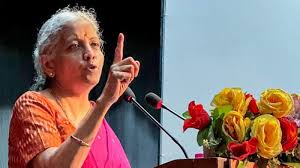
Union Finance Minister Nirmala Sitharaman stated during a post-opening press conference following the opening of the new State Bank of India branch in Pune that Indian banks need to take a more adaptable and proactive stance in order to combat new cyberthreats powered by artificial intelligence.
Her comments came after a high-level meeting with the chiefs of Scheduled Commercial Banks, RBI, NPCI, CERT-In, and Union Minister for Electronics and Information Technology Ashwini Vaishnaw on Thursday to evaluate the risks posed by sophisticated AI models that could be abused to weaponise software vulnerabilities.
According to Sitharaman, consistent digitisation, frequent system upgrades, firewalls, and consumer safety measures have kept Indian banks mostly free of significant incidents involving cyber security violations over the years."This has been an ongoing exercise and Indian banks have done very well for themselves that there has not been a major incident over the decades," she stated. She did, however, warn that the threat posed by sophisticated AI is distinct and poorly understood. We have demonstrated that we are cautious and protective of our clients, yet this may not be enough. They must exist, develop, and get better. However, in order to combat the emerging threats, we need something fresh and far more adaptable," she stated.
The minister stated that in order to assess India's readiness and the changing risk landscape, the Ministry of Electronics and Telecommunications is actively interacting with international governments and IT firms. After the meeting on Thursday, which was also attended by CERT-In DG Dr. Sanjay Bahl and DFS Secretary M. Nagaraju, banks were instructed to collaborate within a coordinated institutional system headed by the Indian Banks' Association. As the head of IBA, the SBI Chairman will spearhead the endeavour. In the upcoming weeks, banks will evaluate what technologies may be used, where more investments are required, and how AI itself can be utilised to combat threats based on AI. Sitharaman explained that this is an IBA-led procedure to find vulnerabilities and examine vendor dependencies rather than a brand-new committee.
In order to improve defensive and monitoring capacities, she advised banks to hire the top cybersecurity experts and specialised organisations and to promptly notify CERT-In and other authorities of any suspicious behaviour. To guarantee early identification and prompt transmission of developing threats, banks, CERT-In, and other organisations were encouraged to establish a strong real-time threat intelligence sharing mechanism.
In terms of geopolitics, Sitharaman recognised the effects of the West Asia issue, especially the Strait of Hormuz's effective closure, which has raised the price of crude oil.We'll see what we can do in light of the Strait of Hormuz crisis. These difficulties are ever-changing. Each problem would be tackled in its own context, she added. "You can't club all of them and say each challenge is being addressed," she stated.
The Minister also highlighted a distinction between the cybersecurity agenda and other policy issues like help for exporters impacted by US tariffs, which was introduced last year, and LPG supply monitoring, which is managed by a group of ministers headed by Defence Minister Rajnath Singh. She reaffirmed that the 2047 banking sector roadmap's Terms of Reference are purposefully broad to allow committees to suggest the size and structure of banks that will be required in the future.
.jpg)
.jpg)
.jpg)
.jpg)
.jpg)
.jpg)