
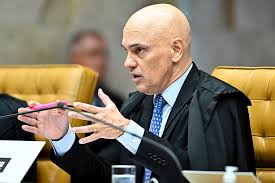
After first adding Brazilian Supreme Court Justice Alexandre de Moraes to its list of sanctions due to his involvement in the trial of former Brazilian President Jair Bolsonaro, the US removed him from the list on Friday.
According to records from the Treasury Office of Foreign Assets Control, De Moraes' wife and the Lex Institute, which she oversees, were both removed from the list. Following a phone call between President Donald Trump and President Luiz Inácio Lula da Silva over the weekend, the Brazilian government applauded the action.
The judge was sanctioned by the Trump administration in July after it was alleged that he had used his office to impose arbitrary pretrial detentions and stifle free speech in Brazil.
According to a senior Trump administration official, the penalties were removed because the US interpreted Brazil's lower house's ratification of a significant amnesty bill as an indication that the country's legal situation was improving. The official discussed the administration's stance on foreign policy priorities while remaining anonymous.
Following several meetings and calls that both administrations have described favourably, the action signifies a melting of sorts in the icy relationship between the two governments. Bolsonaro, Lula's predecessor, was seen by Trump as an ally; the Brazilian leader was even referred to as the "Trump of the Tropics" upon taking office.At a Sao Paulo event on Friday night, de Moraes declared, "This is a victory of Brazil's judiciary." "Brazil's judiciary has never submitted to coercion or threats, and it never will. It continued with boldness, earnestness, and impartiality. The country's sovereignty has triumphed. From the beginning, President Lula declared that Brazil's democracy would not be compromised by any invasion.
Similar accusations were made against Bolsonaro after a crowd of his followers stormed the U.S. Capitol in 2021 to prevent Democrat Joe Biden from winning the presidency. Bolsonaro was accused of masterminding a conspiracy to remain in power despite losing the 2022 election against current President Luiz Inácio Lula da Silva.
Bolsonaro was found guilty and given a sentence of over 27 years in prison. The troubled 70-year-old leader began serving his sentence last month, but because of his bad health, he is still asking to be placed under house arrest. Although his imprisonment did not cause the enormous disruption that his supporters had anticipated, he is still a significant political figure ahead of the elections next year.
The easing of the penalties was described by Brazil's current government as a "big defeat" for Bolsonaro's family.
According to Gleisi Hoffmann, Brazil's secretary of institutional affairs, "it was Lula who put this repeal (of the sanctions) on Donald Trump's desk in a dignifying and sovereign dialogue." "The Bolsonaro family, who are traitors who have plotted against Brazil and the judiciary, have suffered a significant setback."Eduardo Bolsonaro, a congressman and the former president's son, has long been accused by Lula's socialist administration of deceiving Trump about de Moraes and other court members. Eduardo Bolsonaro, for his part, stated that he was "with regret" to learn that de Moraes' sanctions had been revoked.
The younger Bolsonaro declared he would keep fighting for Jair Bolsonaro after declaring in March that he would move to the United States to urge the Trump administration to keep his father out of jail.
Following Trump's reversal, Eduardo Bolsonaro posted on social media that "the lack of internal cohesion and the insufficient support for initiatives pursued abroad contributed to the worsening of the current situation."The Global Magnitsky Human Rights Accountability Act, which targets corrupt officials and those who violate human rights, was mentioned by the Treasury Department when it first sanctioned de Moraes. The use of the act against him, according to De Moraes, was "illegal and regrettable."
Additionally, in July, the Trump administration levied a 40% tax on Brazilian goods in addition to an earlier 10% tariff. The administration justified the duties by claiming that Bolsonaro's criminal prosecution and Brazil's policies constituted an economic emergency.
The action demonstrates that "the U.S. government wants a normal relationship with Brazil's, even though it is a leftist administration," according to political consultant Thomas Traumann, the author of a recent book on Brazil's political splits.
"It is now all about security and trade, and he managed to make Brazil's government somewhat neutral in other Latin American affairs, especially Venezuela," Traumann stated. "Trump removed almost all tariffs it had increased, stopped discussing politics with Lula." "This is a process to demonstrate that Brazil needs to be treated differently in the region."
Following their first private encounter in Malaysia in October and following phone calls, the two leaders began to patch things up at the UN General Assembly in September.
The president of Brazil has stated that he was attempting to lift the sanctions imposed on de Moraes and certain members of his government who were also affected by the legislation, in addition to reversing the tariff rise.
Separately, as the Trump administration orders military action against ships reportedly connected to drug gangs, Lula has called on Latin American nations to assist in preventing a conflict in Venezuela.
Trump issued an order last month to eliminate the additional import taxes on certain agricultural products. The U.S. Census Bureau reports that the United States had a $6.8 billion trade surplus with Brazil last year.
.jpg)
.jpg)
.jpg)