
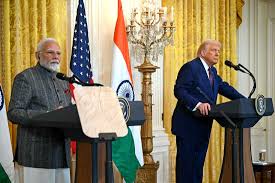
According to US Deputy Secretary of State Christopher Landau, India and the US are "very, very close" to completing the trade agreement and must overcome "that last hurdle" on Tuesday.
After months of negotiations, Landau stated that it was critical for the US and India to "reach some closure" and proceed with the several other topics on the agenda.We understand India's significance on the international scene. I believe that reaching a final agreement on that trade pact is crucial. We've been communicating for months, and I believe we are quite close.On the fringes of the SelectUSA Investment Summit at National Harbour in Maryland, close by, Landau told reporters, "But we have to get over that last hurdle."Landau, who just was to India, stated, "I can just reiterate that I believe that we are very, very close, but I don't have any huge inside information to provide on when that is coming."He stated, "I think it's crucial that we finally sign it, get some closure on that, and move on to the many other issues on our agenda."India is undeniably one of the world's great powers, in my opinion. The largest population in the world now is found in India.
Furthermore, I believe that for many decades, India's enormous economic potential was not fully fulfilled due to the economic models that the country chose to follow.However, I believe that India is now in a position to achieve significant economic growth and pull hundreds of millions of people out of poverty," Landau stated.
On February 2, India and the US revealed the framework of their bilateral trade agreement; on February 7, the deal's text was made public. Last month, Indian representatives visited the US to discuss the trade deal.
As part of the deal, India is requesting preferential access to US markets as the two nations aim to reach USD 500 billion in bilateral commerce by 2030.In accordance with that arrangement, the United States agreed to lower its tariffs on India from fifty percent to eighteen percent. Under the agreement, the 25% duty on Indian goods for purchasing Russian oil had been eliminated, and the remaining 25% was to be reduced to 18%.
However, Trump's reciprocal tariffs, which were enforced under the 1977 International Emergency Economic Powers Act (IEEPA), were overturned by the US Supreme Court on February 20.
In order to guarantee that its interests are safeguarded under the new international tariff framework, India is attempting to recalibrate and redraft the agreement following the Supreme Court's ruling.

.jpg)
.jpg)
.jpg)