
The Gujarat Titans needed three out of two last night at the Narendra Modi Stadium. The Titans prevailed as Washington Sundar swung at Marcus Stoinis and the ball cleared deep midwicket.
It was the 832nd six of the 2026 Indian Premier League, which is producing them at a record rate of one per 12.3 balls, up from one every 16.3 balls in 2022. a four-season increase of 32%. In Twenty20 cricket, the boundary rope has essentially become closer.
However, not every one of those sixes was equally important. Some won games, such as Washington's. By the time they cleared the rope, others were "priced in" already. You'll have a number for each of them by the end of this piece, including that game-winning six that turns out to be less spectacular than it sounded.
Why a six can be worth less than six
The intuition is as follows. A run-projection model predicts where the innings will go based on the present score, the number of overs left, and the wickets in hand. The reasoning behind a commentator's statement that "They're on track for 220" is the same; it's just codified into a figure that changes with each ball.
After eighteen overs, a side is 190 for two. According to the model, they should finish at 215. A six is hit by the batsman. The current score is 196 for 2. However, the model no longer projects 221. Because it had previously anticipated approximately two runs off that ball that went for six—the average yield at that point in the innings—it forecasts about 219.Only around four were added to the prediction, while six were put to the scoreboard. There were already two of those runs priced in.Consider it similar to a stock. The stock remains unchanged if a company reports $5 in earnings when the market anticipates $5. The stock moves if it reports $8, but the change is based on the "surprise margin" rather than the precise amount. The earnings report is number six. The stock move is represented by the delta. The degree to which the outcome surpassed expectations is what counts, not the outcome itself.
A six in the powerplay, when the model does not yet have that run rate built in, shifts the prediction more than a six in the death overs, when the par-score model already expects quick scoring.Delta is defined as the difference in the expected innings total that a ball generates depending on the circumstances in which it was struck. The concept is similar if you've followed ESPNcricinfo's Smart Stats, which measure a player's contribution above what would be expected from an ordinary player in the same circumstance. Our version of that concept, adjusted for IPL data, is called Delta. The idea that context affects value and that not all runs are created equal is more important than the particular framework.
The point is made clear by two particular sixes from this year's IPL. Against the Mumbai Indians, M Shahrukh Khan was chasing 200. His team, the Gujarat Titans, were sinking at 58 for 5 after nine overs. According to the par-score prediction, they would have finished on just 136.The prediction increased to 147 when Shahrukh smashed Allah Ghazanfar for six over long-on off the final ball of the ninth over. His team's predicted total was altered by 11.4 runs—nearly double the scoreboard value—by just one ball. The trajectory was momentarily reset since the six landed just as the Titans' innings was collapsing. (The six was an act of defiance more than a rescue; the Titans finally collapsed for 100. But the model didn't know that yet, which is why the delta was so large. The key is that delta quantifies how much the ball altered expectations at the time of bowling.
A day later, Sunrisers Hyderabad were 226 for 2 and playing freely in the 19th over of their match against Delhi Capitals; the model had already predicted a final total of 240. For a six, Heinrich Klaasen hit Mukesh Kumar back over his head. 232 is the score. However, the estimated final merely changed from 240 to 242. There was a 1.5 run difference. The algorithm had anticipated high scoring from that scenario, thus the six contributed six runs to the scoreboard but just 1.5 to the trajectory. (Sunrisers completed on 242; the forecast was about accurate.)
Both times, the audience applauded in the same manner. They weren't the same shot.832 sixes in form
By the time I pulled the data last night, there were 832 legal-ball sixes in IPL 2026. 4.85 runs was the average delta-per-six. Between 4.1 and 5.5 was where half of the sixes fell. The entire range was between 0.32 and 11.4.
There are two noteworthy aspects of this distribution. First, the center of mass is located below six. Instead of six, most sixes are worth about five predicted runs. The model predicted roughly 1.5 runs from an average ball, which is the stock-market reasoning from earlier in this essay. Six runs are scored with a six. The difference, or around 4.5, is the trajectory shift. Six is added by the scoreboard. Because 1.5 of those runs were already priced in, the forecast moves by less.
Second, the right tail is thin but real. When the batting innings was in trouble, such as during collapses, rebuilds, or close chases, a single boundary jolted the trajectory upward, and that's when the sixes worth actually more than six runs were hit. This season, about thirty sixes have scored more than seven runs. Thirty more are less than three. The middle is when most of the action takes place.
Death sixes have already been priced in.
According to legend, sixes are especially important during the death overs. However, they have the least impact on trajectory change—not because they are poor, but rather because the model already anticipates rapid scoring in overs 16 through 20. A death six validates the prediction.The average estimated total value of a powerplay six is 5.06 runs. The value of a middle-overs six is 4.94. The value of a death six is 4.29. By a wide proportion, death sixes are the least valuable category.
The game-winning goal from last night is precisely on that line. The average score for Washington's six off Stoinis was 4.30 runs, which is nearly the same as the death-six average. The shot won the match; the Gujarat Titans' estimated innings total hardly changed because a six just fulfilled the model's pricing in for quick scoring in the 20th over. The most important ball of the evening was, by trajectory, a perfectly normal death six. However, match value and trajectory value are not the same thing.
Notably, the death overs have the greatest six rate per ball (9.6%), followed by the powerplay (8.5%) and middle overs (7.4%). The period where each six is valued the least is when batters hit sixes most frequently. The phase that produces the most sixes per ball is the one where each six moves the needle the least, but that's not irrational—it's ideal play when wickets don't matter.
Why? Because everyone is working hard in the last overs, the model predicts the highest number of runs per ball of any phase—roughly 1.7. The surprise is roughly 4.3 since a six yields six runs. The algorithm predicts roughly 1.6 runs per ball during the powerplay.
In reality, a powerplay six results in a delta of 5.0, which is greater than what you would get by just subtracting 1.6 from 6. The extra comes from compounding: since the batting team still has the majority of its innings ahead of it, the model marginally raises its estimate for all 80+ balls remaining following a six in the powerplay. The innings is nearly over, thus a fatal six has no future to compound onto. Therefore, a death six does not receive a future bonus, but a powerplay six does.
The leaderboard for volume
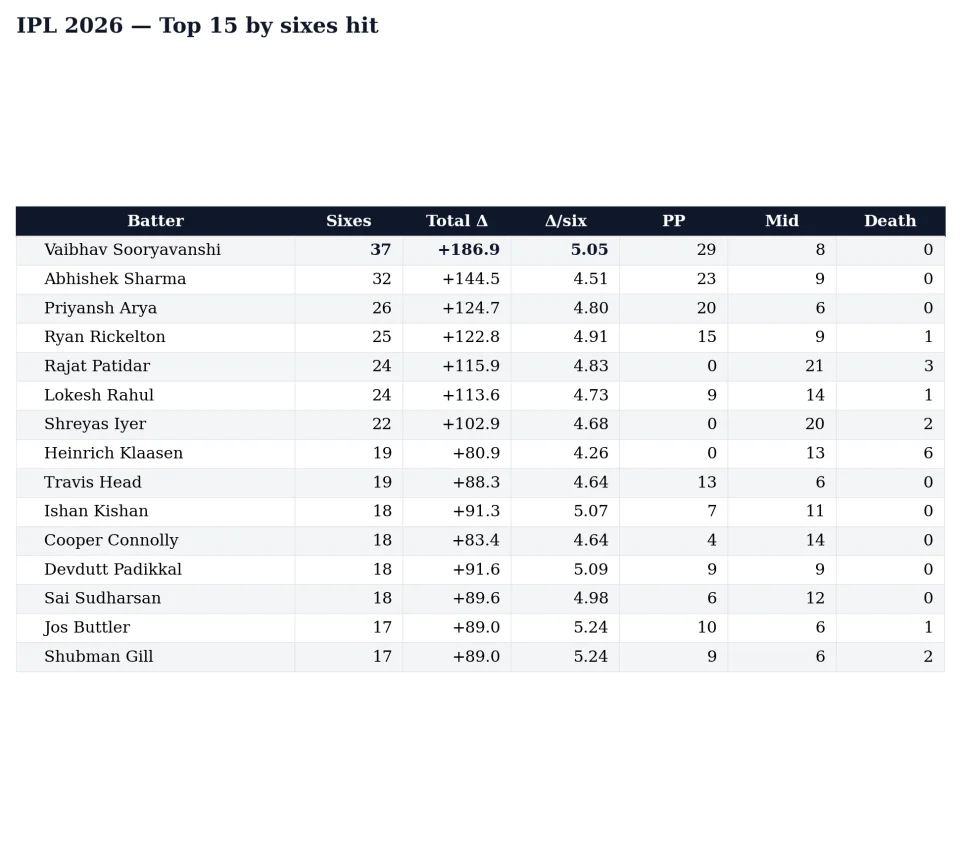
Vaibhav Sooryavanshi leads the season by raw count.He has a mean delta-per-six of 5.05. That is not particularly high, but it is still better than the league norm of 4.85. At a slightly above-average leverage, he is hitting a lot of sixes. Over 37 events, his sixes have a projected match value of almost 187 runs. Although the per-six leverage is more average than the volume indicates, that is the season-high total for sixes in particular.
For a fifteen-year-old, the volume itself is the story; the more engaging reading is the leverage profile.
The view of leverage
The leaderboard changes when the same population is rearranged by mean delta-per-six (with a ten-six minimum to ensure a stable floor):
With 11 sixes at a mean delta of 5.88, Mitchell Marsh leads the leverage rankings.Cameron Green (ten sixes, 5.63), Shubman Gill, Jos Buttler, Prabhsimran Singh, and Ishan Kishan trail him. At 5.05, Sooryavanshi is ranked ninth on this list.
A valid criticism: Marsh may not be a "better" six-hitter despite his high per-six delta. It could indicate that his team has problems on a regular basis. When Marsh hits a six, the average predicted innings total at that point in his team's innings is 173, which is much less than the league average of 198, according to the data. The average estimate at the time Sooryavanshi hits one is 209. Because there are more needles to move, Marsh's sixes force the needle to move more. A six from behind causes a greater trajectory shift than a six from front, therefore his team is behind.
The volume-versus-leverage differential is expressed honestly here. A high delta per six is not "clutch." It is "opportunity created by adversity". Sooryavanshi and Marsh are both hitting sixes—one while pouring on, the other while rebuilding. Differences in circumstance, not talent, are captured by the delta. Both are worthwhile. They are worthwhile in many ways.
Leverage and volume are two different axes.
Three distinctive forms
This season, three batters serve as examples of the three possible sources of sixes.
Sooryavanshi is a pure-play powerplay. Of his 37 sixes, 29 occurred in the first six overs, with eight occurring in the middle. Since Rajasthan doesn't have him there, he has hit zero sixes in the final. He opens, hits, and exits before death strikes.The expert in middle overs is Klaasen. Of his 19 sixes, 13 occurred in the middle overs, 6 in the final overs, and none during the powerplay. The average sixes in the middle overs are 4.45. At 3.85, the death sixes are significantly lower than the league average. Despite the fact that Klaasen's fan reputation is based on those deadly sixes, his overall mean delta-per-six is negatively impacted by them. A six in over 19 with a score already at 235 essentially just verifies what the prediction had previously factored in. The metric is not emotive.
David is the pure-play death-over. Out of his 16 sixes, 12 have come in the dying stages. He strikes them with a mean delta of about 4.5.
None of the three are incorrect. The volume leader, Sooryavanshi, has a good per-six leverage. As a middle-overs specialist, Klaasen's death sixes are scoring less because they frequently come too late to be significant. David is carrying out his duties. The idea is that all three of them are hitting sixes that move the projection by about the same amount per six, while having very distinct roles and phase profiles.
What this isn't
The claim that some sixes are beneficial and others are negative is not being made. All sixes are sixes. They all receive a spot in the highlight reel, win games, and add up to six on the scoreboard.The reasoning is more nuanced than that: the impact of sixes on the anticipated end of an innings varies, and this fluctuation is statistically correlated with phase, score, wickets in hand, and game condition.A few applications. First, it is deceptive to compare six totals between batters who play different positions. It undercredits sixes hit under duress and overcredits sixes hit in large totals. The per-six delta makes it clear that Sooryavanshi vs. David vs. Marsh is not a like-for-like comparison.
Secondly, "six-hitting" is not a single technique. It is not the same to clear the rope at 230 for two and 90 for five. While the second establishes a new trajectory, the first validates an existing one.
Third, both opportunity and talent are measured by the volume leaderboard. Sooryavanshi is an exceptional cricket player; it is unusual for a 15-year-old to knock more than thirty sixes against international bowling. However, in the IPL 2026 powerplay, he is the best volume hitter. That's the exact assertion. "Best six-hitter" needs further explanation.
Additionally, a more general perspective is that although the death six is stunning, it primarily verifies the innings' earlier events. Although the powerplay six appears standard, it actually alters the direction of the innings. When wickets are irrelevant, hitting sixes at the end is the best tactic, and batters are correct to do so. However, the assessment of those sixes should show that a powerplay six is establishing a trajectory, whereas a death six is confirming one.

.jpg)

.jpg)

.jpg)