
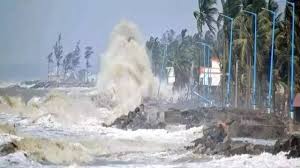
There is a greater chance of a cyclone later this week due to a rapidly intensifying weather system in the southeast Bay of Bengal, which has prompted increased caution along the eastern coast.
A low-pressure region that developed over the Malacca Strait and the nearby South Andaman Sea has already strengthened into a well-marked low-pressure system, and it is predicted to turn into a depression today before intensifying further, according to the most recent weather reports.
However, no forecast regarding its track, impact, or landfall has yet been made public by the India Meteorological Department (IMD).
Over the next 48 hours, the system will intensify.
The low-pressure system formed close to the Malacca Strait, progressively proceeded toward the South Andaman Sea, and then intensified over open waters, according to global weather models and meteorologists.Over the next 48 hours, forecast models predict that the system will continue to consolidate over the southeast Bay of Bengal and become a deeper system as it moves west-northwest.
Rain may fall in Odisha, but there won't be a significant landfall.
Even if the system reaches its maximum strength, preliminary regional estimates indicate that Odisha could not be hit hard by the cyclone.
Rather, it is anticipated to make landfall in southern Andhra Pradesh or Tamil Nadu, making Odisha more susceptible to rainfall and winds that are heavy with moisture.
Global projections, meanwhile, point to a notable increase in wind speed across the ocean. Wind gusts are predicted to rise starting tomorrow, maybe reaching 80 km/h and reaching 60–70 km/h. By the morning of November 27, winds may reach the 100 km/h mark, worsening the sea conditions.
The disturbance is still far from the coast, but it is still being closely watched, according to Odisha's Revenue and Disaster Management Department.
Weather researcher Sandeep Patnaik added that the maritime conditions close to the southeast Bay are currently "highly supportive" for quick intensification, building on the strengthening trend.
He claims that a larger warm sea surface and a strong wind influx from Pacific waters will probably hasten the system's intensification over a brief period of time, especially between November 26 and 30. He pointed out that the storm's final power over the ocean will be determined by this stage.
.jpg)
.jpg)

.jpg)
.jpg)
.jpg)