
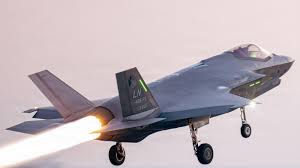
Stealth is a promise, not a guarantee. The US Air Force's F-35A Lightning 2 is the most costly weapons program in history, with the goal of slipping into the most heavily defended airspace undetected.
Despite this, the Pentagon revealed that an F-35A had to make an emergency landing at an unidentified American location in the Middle East on Thursday after flying a combat mission over Iran. Iran's Islamic Revolutionary Guard Corps (IRGC) claims responsibility for the aircraft strike. The US military stated that it is investigating the claim.
Captain Tim Hawkins, a spokeswoman for Central Command (CENTCOM), stated that the F-35A was on a combat mission above Iran when it was diverted. The aeroplane landed successfully, and the pilot is stable.
Iran has developed air defence systems that use passive infrared sensors rather than radar to target aircraft. This method had already proved effective in Yemen when used by Iranian-backed Houthi rebels.Passive devices are especially harmful because they produce no radio signals of their own. A radar-warning receiver on an aircraft detects incoming radar emissions, whereas a passive infrared tracker remains silent until the time of collision. These homemade or jury-rigged technologies give little to no warning of a threat, let alone an impending attack.
While the F-35A has its own Distributed Aperture System, which consists of six infrared cameras that provide 360-degree situational awareness, detection and escape are distinct issues.
The Houthi rebels, armed with far less sophisticated systems than Iran, had previously demonstrated this discrepancy. US F-35s flying against Houthi air defences had to take evasive manoeuvres to avoid being attacked by surface-to-air missiles.The course of Operation Epic Fury has exacerbated this vulnerability. General Dan Caine, Chairman of the US Joint Chiefs of Staff, informed reporters that US planes are now flying farther east and deeper into Iranian airspace. Iran's road-mobile air defence systems, which are difficult to identify and destroy, are located in this region.
Following each battle, road-mobile systems can be moved and hidden in typical terrain. They may be disguised almost anywhere and will continue to pose a threat on the battlefield even after permanent air defences are destroyed.
Non-stealthy A-10 ground attack jets and AH-64E Apache helicopters are flying along the Iranian coast across the Strait of Hormuz, indicating that the US considers Iran's western airspace controllable and safe.
Since the beginning of the war, the United States has lost more than a dozen combat aircraft. On March 2, three F-15E Strike Eagles were downed during a friendly fire incident in Kuwait. A KC-135 Stratotanker crashed in western Iraq on March 12, killing all six crew members.
.jpg)
.jpg)

.jpg)