
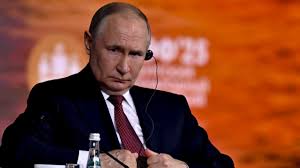
Vladimir Putin, the president of Russia, has commended India's technological prowess, pointing out the nation's expanding importance in the software sector and characterising Indian programmers as internationally renowned. Speaking at the Saint Petersburg International Economic Forum in Russia, Mr. Putin claimed that India is among the top nations in the world for software creation and information technology. He pointed out that the nation produces highly qualified IT workers and holds a sizable portion of the world's software market.I'd want to extend a warm welcome to India, one of our most important partners and a major force in the IT sector. It holds a substantial portion of the worldwide software business, according to Putin.
"We are aware of the Indian people's skill, education, and competence. They have become well-known throughout the world, particularly in the field of coding," he continued.
"Very good, trust-based, brotherly relations in all senses of the word" exist between Russia and India, he stated during the meeting.
His comments were made in the context of a larger conversation on how the world economy is evolving and how emerging countries are becoming more important. India's technological accomplishments, according to Mr. Putin, are a testament to the country's people resources and highly qualified workforce. He also emphasised the long-standing alliance based on trust between Russia and India.
The remarks come at a time when India is growing its market share in industries including software services, digital payments, artificial intelligence, and technology exports. Indian engineers and technology companies are becoming more well-known in international markets; many of them have prominent positions in start-ups and multinational corporations.
Putin added that BRICS surpassed the G7 in 2020 and that this difference is predicted to widen.In 2020, BRICS surpassed the G7, and this difference is predicted to widen. BRICS will continue to expand at a faster rate. The BRICS countries are predicted to develop by more than 4% annually, while the G7 is only forecast to rise by 1.1%.
.jpg)
.jpg)
.jpg)
.jpg)
.jpg)
.jpg)