
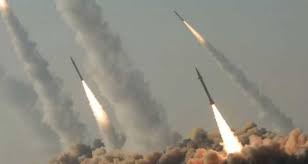
Iran fired drones and ballistic missiles toward Bahrain and Kuwait, according to the country's government on Saturday. The foreign ministry declared that they had been intercepted and urged Iran to immediately stop attacking its neighbours in the Gulf.
The announcement was made just hours after the US military claimed to have shot down Iranian ballistic missiles and drones that were aimed at the Gulf Arab allies and the Strait of Hormuz on Friday, while also hitting some of the Islamic Republic's coastal surveillance radar sites in retaliation. This firefight further strained a precarious ceasefire with Tehran.
The Trump administration is increasing pressure on Iran to reach an agreement to end the crisis, which coincides with the exchange of strikes.
Iran fired seven ballistic missiles against Kuwait and Bahrain, according to US Central Command's social media post on Friday night. Six of the missiles were intercepted by US forces, while the seventh missile failed to reach its target. According to the military, there have been no instances of US servicemen being harmed.
The US shot down four Iranian drones that were headed toward the Strait of Hormuz earlier in the day, prompting the firing of the ballistic missiles."The attack drones posed an immediate threat to regional maritime traffic," the US Central Command posted on social media.
While Bahrain sounded air raid sirens and advised citizens to flee to the closest safe spot and obey government orders, Kuwait's military said that forces were intercepting missiles and drones hitting the nation.
The US Navy's 5th Fleet in Bahrain, a small Gulf island nation, and the Ali Al Salem airport, which houses US forces in Kuwait, were the targets of Iran's Revolutionary Guard, according to the state-run IRNA news agency.
In reaction to Tehran's chokehold on the vital route for international oil and natural gas shipments, which has caused energy prices to soar and presented political challenges for President Donald Trump's Republican Party ahead of the midterm congressional elections, the US military is imposing a blockade on Iranian ports.
The radar sites, including an island in the strait, were struck, according to US Central Command, "to defend against further attacks."
Trump says the US-Iran dispute will end quickly
The war's precarious ceasefire and attempts to come to an agreement to prolong it have been stretched by the most recent round of back-and-forth attacks. Iranian drones severely damaged a passenger terminal at Kuwait's main airport earlier this week, resulting in one fatality, numerous injuries, and a lengthy closure of the airfield.
Trump told reporters on Friday that "the situation with Iran seems to be going quite well," despite the attacks sparking fresh worries that the ceasefire would break down.At a gathering with farmers in Wisconsin, Trump declared, "We're going to come out of Iran very quickly and it's going to be very strong one way or the very tough way."
Trump seems more and more trapped in a dispute that has fallen into a holding pattern. A week ago, negotiators from the US and Iran came to a tentative deal to begin a new round of discussions on Iran's nuclear program and prolong the ceasefire by 60 days. However, Iranian officials have not publicly indicated that they will approve the deal, and Trump has demanded unspecified revisions.
Trump told NBC's "Meet the Press" on Friday that the reason it was taking so long was because "it's a very hard thing for them."They will have to perform tasks that they never anticipated. It takes some time, and they have no other option," he stated during the interview.
Israeli attacks on Lebanon are still ongoing
Additionally, his administration has highlighted the most recent truce that Israel and the Lebanese government reached this week following US-mediated negotiations in Washington. Hezbollah, a militant organization supported by Iran, has rejected the deal, and fresh strikes have made it even more vulnerable.
Nine towns, including one that has provided refuge to hundreds of people displaced by the conflict, were warned to evacuate after the Israeli military attacked several areas in southern Lebanon on Friday. Nine individuals were killed in six southern Lebanon areas as a result of the strikes, according to the state news agency.
In a confrontation with militants in southern Lebanon on Friday, the Israeli military said that two troops were injured, one seriously.Since Iran has insisted that any long-term ceasefire include Lebanon, the fighting in Lebanon, where Israeli forces have taken control of significant portions of the south, also jeopardises attempts to put an end to the Iran War and reopen the Strait of Hormuz
In addition to the drone interception in the Strait of Hormuz, the US military reported earlier on Friday that US troops had boarded an Iran-affiliated sanctioned oil tanker in the Indian Ocean in an effort to stop Iran from making money off of its oil and other products.The US also imposed fresh sanctions on a number of individuals, businesses, and vessels in order to target Iran's oil industry.
.jpg)
.jpg)
.jpg)
.jpg)
.jpg)
.jpg)