
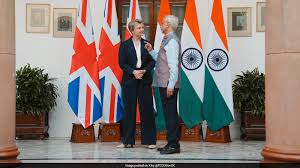
Every pillar of the bilateral alliance benefits from UK Foreign Secretary Yvette Cooper's first visit to India, from a Bengaluru university campus to vital minerals and marine security.
British Foreign Secretary Yvette Cooper concluded a two-day official visit to India on Wednesday, June 3, leaving a trail of agreements that indicate the swift development of one of the most important bilateral ties in the world.
As Britain's top diplomat to India, Cooper, who holds the position of Secretary of State for Foreign, Commonwealth, and Development Affairs in the Labour government, chose New Delhi as her first destination; officials on both sides called her decision thoughtful and significant.
A Review and Acceleration of a Partnership
The first yearly review of India-UK Vision 2035, a comprehensive blueprint approved when Prime Minister Narendra Modi visited London in July 2025, was the focal point of the visit. Cooper discussed the framework's five pillars—growth, technology and innovation, defence and security, climate and clean energy, and education—during lengthy discussions with External Affairs Minister Dr. S. Jaishankar and a separate meeting with Prime Minister Modi.
Both sides spoke in a tone of guarded hope. Both ministers urged the Comprehensive Economic and Trade Agreement (CETA), a historic trade agreement that required years of arduous negotiations to finalise, to go into effect as soon as possible.
Boots on the Ground: Strengthening Military Relations
The introduction of a military instructor exchange between Indian and British training schools was perhaps the most subtle but important move in the security sector. Defence analysts view these people-to-people military interactions, despite their small scale, as fundamental steps in fostering confidence that frequently come before more extensive operational cooperation.
Liverpool Visits Bengaluru
Giving the University of Liverpool a Letter of Approval to open a campus in Bengaluru in accordance with India's New Education Policy was one of the visit's most obvious outcomes. Cooper, Jaishankar, and Education Minister Dharmendra Pradhan were present when the news was made. The school is anticipated to start accepting students in the upcoming academic year.
Protecting Supply Chains and the Seas
The visit's deliverables were completed by two further agreements. In order to strengthen cooperative security architecture across vital sea lanes, King's College London and India's National Maritime Foundation have signed a Memorandum of Understanding to establish a Regional Maritime Security Centre for Excellence, which will be anchored within the Indo-Pacific Oceans Initiative.
Cooper also collaborated with G Kishan Reddy, Minister of Coal and Mines, to establish the UK-India Critical Minerals Supply Chain Observatory, a collaborative system to track and diversify supply chains for minerals necessary for the production of modern technology and renewable energy.
The Greater Picture
The Comprehensive Strategic Partnership between India and the UK has progressively progressed beyond the customary warmth of historical memory and community relations. Cooper's visit indicates that, under the new Labour government, London sees New Delhi as a strategic priority to be aggressively enhanced rather than as a legacy relationship to be preserved.
The first-ever Ministerial Dialogue on Education, which both parties stated they planned to hold shortly, is the next significant event to keep an eye on.
.jpg)
.jpg)
.jpg)
.jpg)
.jpg)
.jpg)