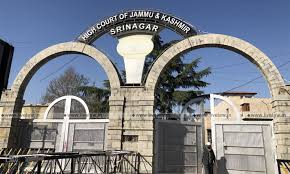
According to the ruling of the Jammu & Kashmir and Ladakh High Court, if an employee's removal from government service involves the state's security, the President or a Governor may do so without conducting a departmental investigation or giving them a chance to be heard.
The ruling was made in response to an appeal that the government of Jammu and Kashmir filed against a single-judge ruling that had overturned the termination of a police constable who was suspected of engaging in anti-national activities.
The then-Governor's 2004 dismissal of Ghulam Mohammad Tantray, a constable in the Jammu and Kashmir Police, was sustained by a Division Bench made up of Justices Sanjeev Kumar and Sanjay Parihar.
Tantray joined the police department in 1991. The Zadibal police in Srinagar arrested him in 2004 on suspicion of violating the Arms Act and Section 120-B of the Ranbir Penal Code, which was in effect in J&K until 2019. After his detention, the government dismissed him without a departmental investigation, citing Section 126(2)(c) of the former Jammu and Kashmir Constitution, which is equivalent to Article 311(2)(c) of the Indian Constitution.
The dismissal was overturned by a single-judge panel, which called it "flawed" and "without reasons" and noted that the government had not provided an explanation for abandoning an existing departmental investigation prior to exercising the constitutional protection.
"Secondly, except to the extent recognised by clause (2) of Article 310 of the Constitution of India, the government has no power to restrict or give up its prerogative of terminating the services of its employees at pleasure under any contract made with the employee," the statement continued.
"Dismissal, removal, or reduction in rank of persons employed in civil capacities under the Union or a State" is covered by Article 311 of the Constitution. No civil worker may be "dismissed or removed or reduced in rank except after an inquiry in which he has been informed of the charges and given a reasonable opportunity of being heard in respect of those charges," according to Article 311(2).
The Division Bench noted that the term "security of the State" has a very high threshold, noting that "it generally concerns terrorism, espionage, militant links, activities threatening the sovereignty and integrity of the country, and grave anti-national conduct, etc."
The Bench noted that the satisfaction thus attained by the President or the Governor must inevitably be a subjective satisfaction, which may be reached as a result of secret information received by the government about the impending danger to the security of the state and like matters. It further noted that other factors may be considered, weighed, and balanced in order to reach the requisite satisfaction whether or not holding an inquiry would be expedient.
The court went on to say, "The constitutional courts are not barred from judicially reviewing such satisfaction if it is vitiated by mala fides, absence of relevant material, arbitrariness, and above all, if it does not generally concern the security of the State, even though the judicial review of such satisfaction drawn by the President/Government on the aid and advice of the Council of Ministers is very limited and constricted."
J&K's application of Article 311(2)(c)
Since 2021, the J&K Lieutenant Governor's administration has fired 91 public servants in accordance with Article 311(2)(c) of the Constitution.
This year alone, seven of these workers were fired due to alleged militant ties.Mehbooba Mufti, the president of the People's Democratic Party and former chief minister, had already written to Chief Minister Omar Abdullah requesting an immediate review of these dismissals. Such dismissals have been denounced by Valley political parties as "arbitrary terminations" intended to "disempower" Kashmiris.
.jpg)
.jpg)
.jpg)
.jpg)
.jpg)